Blog

Insurance

Home Insurance Discounts Guide

Originally published by Insurance.com.

Home insurance companies offer discounts that can save you hundreds, but it’s up to you to make sure you’re getting all the homeowners insurance discounts you deserve. That way you can ensure you have sufficient coverage, but at the same time getting the cheapest home insurance for your particular situation.

Bundling insurance, staying with an insurer, renovating your house, adding a security system and setting up automatic billing can all save you money on your home insurance bill.

At the time of a new policy, insurers will likely give you a discount for bundling auto and home insurance or staying with that company for many years. But you will have to notify your insurer about other possible discounts, such as when you add a sprinkler system or new wiring to your house.

Don’t wait for renewal time to tell your insurer. You can start enjoying the benefits of discounts today.

This guide will look at how home insurance discounts work, examples of home insurance discounts that most insurers offer, limits on how much you can save on discounts and other ways to save on your home insurance bill other than discounts.

How do home insurance discounts work?

Similar to car insurance, insurers base your home insurance rates on three factors:

Base rate — This takes into account your risk factors, such as the location and building materials and age of your home.

Surcharges – Surcharges raise your rate. Filing claims lead to surcharges on your home insurance bill, as can having a certain breed of dog or other items that are seen as risky to a home insurer.

Discounts – Discounts help lower your rate. There are various types of discounts available and they vary by state and company. While one insurer may offer you a 10 percent discount for paying your bill in full, another might only give you a 5 percent discount. But every little bit helps, right?

When to ask for home insurance discounts

You don’t have to wait to renew your policy to get discounts. Contact your home insurance company and provide them documentation in cases such as a new roof or security system.

If you have a new policy, look through your insurer’s information for any discounts for which you might be eligible. Don’t be afraid to ask your insurance company if you’re not sure if you’re eligible for a discount.

Here is a list of home insurance discounts that could save you money:

Home and auto bundle

This is one of the biggest discounts you can get. In fact, Travelers gives up to 15 percent to bundle your auto, home, and even an umbrella insurance policy. Allstate claims you can save up to 25 percent on your auto premiums and up to 35 percent off your home premiums when you bundle your policies. Saving on both sides is a big plus to having multiple policies with the same insurance company.

Insurers give generous bundling discounts (also called multi-policy discounts) because you’re giving them more of your business.

An insurer will usually give you the discount when you start your policy or begin bundling multiple types of insurance. If you bundle, make sure you’re getting the discount that you deserve.

Here are average homeowners insurance savings, as a percentage, by state, for bundling home and auto coverage, according to Insurance.com’s homeowners insurance rate analysis of major insurers for nearly every ZIP code in the country. Findings showed a nationwide average savings on home insurance of 20 percent. You can save about 8 percent, on average, on your car insurance when you bundle it with your home coverage.

Home and auto insurance bundle discount by state

Loyalty

If there is something that insurers love more than bundling, it’s loyalty. These types of discounts are often up to 10 percent.

One caveat: You usually have to remain in good standing and many insurers only offer the discount to people who are claims-free for a certain period of time.

Loyalty discounts are great reasons to stay with your insurance company, but that doesn’t mean you shouldn’t shop around. It’s still a good idea to get quotes from other insurers every few years at a minimum.

Your insurer’s 10 percent loyalty discount might pale in comparison to another insurer’s new customer discount and other perks.

New customer

Changing insurance can save you up to 10 percent. Beware: Most insurers only include the discount for a limited period. So, you’ll want to figure out whether the 10 percent discount for two years is worth changing your insurance — and losing any loyalty discount.

Being claims free

Insurance companies don’t like to pay claims. They dislike it so much that you can get as much as 20 percent off your bill from some insurers if you don’t file claims for 10 years. For a lower discount, some insurers are okay with only five years of no claims.

Before filing a claim, it’s always good practice to figure out whether it’s worth it.

Let’s look at an example. Let’s say a leaky roof damaged your ceiling. There is a watermark on the ceiling, but there isn’t any other damage. You have a $1,000 deductible and repairs will cost about that amount.

In this case, it’s best to handle the repairs on your own dime. If you file a claim, you’d have to pay the $1,000 deductible AND your rates will likely increase because you filed a claim.

In this case, you’d wind up paying more for filing a claim than paying for it yourself.

Before filing a claim, you should make sure that you’re not going to actually lose money in the long run because of filing a claim.

Setting up automatic payments

One of the easiest ways to save on your home insurance is by setting up automatic payments. Many credit cards have a similar program.

You allow the company to automatically get paid through your bank account. If you’re comfortable giving your insurer that information, many insurers give a 5 percent discount for setting up automatic payments.

Paid in full

Paying off your annual home insurance bill can get you a discount of about 5 percent.

Insurers like when members pay in full because it means they have their money and won’t have to send more bills. You like it because you won’t have to pay monthly fees — and you can get a discount too.

Early signing

Many insurers offer a discount of about 10 percent if you sign up for a new policy before your current one expires. Insurers would rather you stay with them than shop around. This early signing discount is one way to keep you on board.

Home security

Depending on the security enhancements and type of alarm system, you could get as much as a 20 percent discount. The 20 percent figure is for a high-end central alarm security system that alerts the police of a break-in and includes fire protection.

There are smaller discounts of usually around 5 percent for dead bolt locks and passive burglar alarms that sound, but don’t alert the police directly.

Fire sprinklers and smoke detectors could also get you a small discount so check with your insurance company to see if you’re qualified.

Retirees

Retirees over 55 can enjoy a 10 percent discount. The reasoning is that retirees are more often at home so they will spot a problem earlier than someone who works 9-to-5.

For instance, imagine if a basement pipe bursts and floods the basement one morning. A retiree who spends time at home during the day will likely hear the water flowing and call a plumber — after hopefully turning off the water to the home.

Being home can avert a flooded basement and thousands of dollars’ worth of damage, which is why insurers provide the senior retiree discount.

Technology

New in-home technology protects homeowners from expensive clean-up costs and protects them from disaster.

Take the example about the flooded basement above. There is now technology that actually stops problems immediately.

Active sensors not only sound an alarm, but the latest technology can shut off water or gas when there’s a break. No one has to be home for the technology to kick in.

This kind of technology can come with a hefty price tag, but you can make up part of the cost with an in-home technology discount of as much as 10 percent.

Non-smoker

Do you need another reason to kick the habit? You can actually save money on your home insurance by not smoking.

Improved building materials, fire suppression systems, and fire safety education have led to fewer structure fires, but smoking-related fires and fatalities remain a problem. The National Fire Protection Association reported 90,000 smoking-material fires in the U.S. in 2011. These fires caused $621 million in property damage.

By not smoking, you’ll not only improve your health and save the $7-plus-a-pack you spend on cigarettes, you can get a discount of as much as 15 percent on your home insurance.

New construction and renovations

You can pay less on your insurance by living in a new home or renovating your home.

Improving infrastructure, such as plumbing, wiring or a roof can lead to a discount.

Installing a more durable Class 4 roof or being certified by a Leadership Energy and Environmental Design (LEED) organization as a “green” home could get you up to a 10 percent discount.

Living in a gated community or belonging to a neighborhood watch or homeowners association

A gated community, a neighborhood watch and a homeowners association show insurers that you’re a less risk.

Insurers often give an at least 5 percent discount, but some offer as much as 20 percent off. So, if you fit any of these situations, contact your insurance company.

Married or widowed

Being married or widowed can get a 5 percent discount. Having a spouse means you’re likely more settled than if you’re single. Plus, there is a better chance that someone will be in the house than if you’re single.

Widowed people are usually older and more likely to be at home more too.

Inflation adjustment

You can get a discount if you’re willing to increase your home’s dwelling coverage to reflect an inflation increase. Insurers are then able to raise the coverage of your home in case of inflation.

This lets the insurer keep up with rising costs and home rebuilding costs rather than increase the dwelling coverage at renewal time.

Limits on homeowners insurance discounts

You’ve read about all of the above discounts and you’re adding them up in your head. Now, for the bad news — Insurers usually place limits on the total percentage of discounts you can receive.

This limit is often set at 25 percent. So getting discounts is great, but at the end of the day what you need to look at is the final premium you’ll pay. A company with a lower base premium and fewer discounts may beat out a company that offers many discounts but has a higher overall premium.

How else can you save on home insurance other than discounts?

An easy way to decrease your homeowners’ insurance premiums is to raise your deductible. By simply increasing your deductible from $500 to $1,000, you could save hundreds each year. Our “Homeowners insurance deductibles: How to choose the right one” article provides rates by state and shows the savings earned with a higher deductible.

If you are deciding whether to increase your deductible, make sure you have access to money to pay the deductible if you need work. A good idea is to set aside the deductible amount so you will have that money ready in case you ever need it.

Home insurance discounts are not always automatically applied to policies so it’s a good idea to review your insurer’s discounts now to see whether there are any that would benefit you. And discount and premiums change, so at every renewal, you should check with your insurer to see if there are any new discounts you’re eligible for and also shop around to make sure your insurer is still the best one for your needs.


Insurance

Health Insurance Guide: Which Plan is Right for You?

Originally published on Insurance.com.

Which health insurance plan is best for you?

The answer to that question really depends on a number of factors that pertain to your specific situation. When comparing health plan options, take these factors into account:

  • Your health
  • Your family’s health
  • Your health care providers and whether they accept the insurance
  • Your financial situation
  • Whether you want to pay more upfront via premiums
  • If you want flexibility and not having to ask for referrals to see a specialist

Once you review those factors, choosing a health plan is much easier.

The five most common types of health insurance plans are:

  • Preferred provider organizations (PPOs)
  • Health maintenance organizations (HMOs)
  • High-deductible health plans (HDHPs)
  • Point of service plans (POS)
  • Exclusive provider organization plans (EPO)

The two most common health plans have been generally HMOs and PPOs, but HDHPs have become a lower-cost health insurance option for employers over the past decade. POS and EPO plans are options provided by some employers and health insurers, but they’re not nearly as common as HMOs, PPOs, and HDHPs.

In this guide, we provide information about each of these plans to help you make the right decision for your circumstances. We will go through each of the five plan types and highlight the differences.

What is a PPO?

PPO stands for preferred-provider organization. Premiums and deductibles are usually much higher for a PPO compared to an HMO, but that comes with greater flexibility.

About one-half of enrollees in employer-based health plans are in a PPO. Though it remains the most utilized type of plan, the number has been falling in recent years as employers turn more to HDHPs as a way to contain health care costs.

You usually don’t have to select a PCP in a PPO plan, and you can choose from more healthcare providers than an HMO because PPO networks are usually larger. PPOs allow you to get both in-network and out-of-network care — though out-of-network providers will be covered at a lesser percentage. You can also see a specialist without a referral.

Though a PPO gives you more independence, this doesn’t mean that you have complete access to the health care system without any oversight. A health plan may still require you and a physician to get approval for a costly service, such as an MRI.

In addition to higher premiums, PPOs usually have a deductible that you have to meet before the health plan pays for care.

Kaiser Family Foundation reports the average deductible for an individual PPO plan is $1,028. Once you’ve reached your deductible, your insurer begins to pick up its portion of the coinsurance.

The plans also include an out-of-pocket maximum for in-network care. If you reach your out-of-pocket maximum, all costs are covered by your insurer. A plan’s out-of-pocket maximum can vary widely, so you’ll need to check to see the out-of-pocket maximum for your plan. For Marketplace plans through Obamacare, the maximum out-of-pocket limits for 2017 are $7,150 for an individual plan and $14,300 for a family plan.

The main benefit of a PPO is flexibility, but it does come at the cost of higher premiums and a deductible that you will have to pay before your insurer starts paying for care.

When a PPO might be right for you:

  • You want the flexibility to go out of network and not need to get referrals.
  • Flexibility is more important to you than paying higher premiums.
  • You would rather pay higher premiums, but likely pay less for the health care services.

What kind of person should opt for a PPO: Someone who utilizes health care regularly and sees specialists or wants to have the option to see a specialist without getting a referral.

What is an HMO?

HMO stands for health maintenance organization and makes up about 15 percent of health plans. It is known for its lower premiums and restricted network of doctors and hospitals, which means you sacrifice flexibility for lower upfront costs.

You’ll likely pay less in premiums for an HMO compared to a PPO – sometimes significantly less.

HMOs require that you name a primary care physician (PCP) who “coordinates” care, meaning your primary doctor must refer you first in order to see a specialist. HMOs usually don’t have deductibles (or they are lower than other plans). Instead, you pay copays for office visits, tests, and prescriptions.

One drawback to an HMO is that these plans usually don’t allow you to go outside your network for care. If you do, you’ll need to pay for the care on your own. An exception is if you need emergency care, which requires the facility (but not necessarily the providers) to bill as in network.

Not all providers accept HMOs, so before choosing an HMO, make sure your provider or providers accept the plan.

When an HMO might be right for you:

  • You have a primary care physician and other providers who are in the HMO network.
  • You don’t see many specialists and don’t need referrals often.
  • You don’t mind the limitations of only seeing providers in your network.
  • Cost is more important to you than flexibility.

What kind of person should opt for an HMO:  Someone who wants to pay as little as possible in premiums though not have to face high deductibles. An HMO could be a good option if you have a PCP and your other health care providers are already in the HMO.

What is an HDHP?

HDHP stands for high-deductible health plan, which is also sometimes called a CDHP (consumer driven health plan). HDHPs have grown in popularity as more employers have begun offering the plans as a way to contain health care costs.

Nearly one-third of workers have an HDHP.

Unlike the other plans, an HDHP can vary depending on the specific plan. For instance, one HDHP could be very similar to an HMO, while another could look more like a PPO. The critical piece of an HDHP is the size of the deductible and Health Savings Account that is attached to it.

The deductible is usually higher in an HDHP compared to other plans. The IRS defines an HDHP as any plan with a deductible of at least $1,300 for an individual and $2,600 for a family. You need to pay that amount for care before your health insurance chips in.

The average HDHP deductible is a little more than $2,000, but one-fifth of HDHP plan enrollees have a deductible of more than $3,000, according to the Kaiser Family Foundation.

You’ll want to keep that in mind if you choose this plan, and you should set aside money for the deductible in case you need it.

HDHPs typically feature a Health Savings Account, which allows you to save money pre-tax to pay for qualified medical expenses. Some employers seed money in employee HSA accounts to help pay for care, so you’ll want to see if your employer provides money to employee HSAs when making a health plan decision.

Much like a PPO, your insurer will begin to pay its share of the coinsurance once you’ve reached your deductible. Your insurer will cover all costs once you’ve hit your out-of-pocket maximum.

HDHP usually have lower premiums so they can be a less costly plan option — as long as you don’t need a lot of medical care. HDHPs might be a good idea if you are young and healthy, but could be costly to older adults or young families.

Before deciding on an HDHP, think about your next year of potential health care costs to see whether the lower premiums will more than offset the potential costs of care.

When an HDHP might be right for you:

  • You don’t have many health care costs, and you don’t expect to have many costs over the next year.
  • You’d rather pay less upfront costs in premiums with the understanding that the higher deductible means you’ll pay more out-of-pocket if you need care.
  • You don’t have children and/or a spouse on your plan who may use a lot of health care services.

What kind of person should opt for an HDHP: Someone who is healthy and doesn’t expect to use many health care services within the next year. You want the cheapest premiums and don’t mind having to pay a high deductible if you need a lot of care.

What is a POS?

POS stands for point of service plan and makes up about 10 percent of health plans. POS plans are not nearly as common as PPOs, HDHPs, and HMOs. POS plans are a hybrid of PPO and HMOs. In fact, point of service means that the health care consumer gets to choose whether to use HMO or PPO services each time you see a provider.

POS plans usually have similar rules to HMOs (for instance, you need to choose an in-network physician as your PCP), but you can see an out-of-network physician for a higher fee in a POS plan.

When a POS might be right for you:

  • You have a PCP in the POS plan.
  • You want the flexibility of going out of network like a PPO — and don’t mind paying the higher out-of-pocket fees when you need to go out of network.
  • You’re good at keeping health care receipts. You don’t mind filling out forms and sending in bills for payment if you get care out of network.

What kind of person should opt for a POS: Someone who likes being able to go out of network for care, but also wants a PCP coordinating your care.

What is an EPO?

EPO stands for exclusive provider organization and is a managed care plan that requires you to go to doctors and hospitals in the plan’s network.

You don’t need to choose a PCP or need a referral, so in that sense, it’s similar to a PPO, but you will only receive coverage for providers in your network. Other parts of an EPO plan are similar to an HMO, such as having a limited network of doctors and hospitals. You can’t get care outside the network unless it’s an emergency.

Much like a PPO, you need to get approval from your health plan in order to get what’s deemed as an expensive service.

When an EPO might be right for you:

  • You want the flexibility of a PPO and don’t need a referral as long as you stay in-network.
  • You’re OK having a limited network of doctors and facilities like an HMO.
  • You want a network like an HMO, but don’t want to choose a PCP.

What kind of person should opt for an EPO: Someone who doesn’t mind have a limited number of doctors and facilities and would rather not have to get a referral to see a specialist.

What is the difference between HMO, PPO, HDHP, POS and EPO?

It’s open enrollment season at your job and your employer offers you a choice between the three biggest plan types: HMO, PPO, and HDHP. Which is best? It really depends on your financial and medical situation – and preferences.

For instance, would you rather the flexibility of not having to go to a smaller group of providers in an HMO and don’t mind paying more upfront for your care via premiums? Then, a PPO might be right for you.

Do you not care about having a large network of providers, but paying as little as possible for health care is more important to you? Then, an HMO could be perfect.

Do you not use medical services often and you want a plan that will protect you, but not cost much in terms of upfront premiums? Then, an HDHP could be the direction to go.

Choosing the right health insurance plan is a personal decision and depends on your situation and preferences. Whether you ultimately choose a PPO, HMO, HDHP, POS or EPO, take costs, flexibility, coverage and convenience into account when making that decision.

Type of plan Average deductible* Require PCP? Need referrals? Out of network care
HMO $917 Yes Yes No
PPO $1,028 No No Yes
HDHP $2,199 Varies Varies Varies
POS $1,737 No No Yes, but costlier
EPO NA No No No

*Kaiser Family Foundation, 2016 Employer Health Benefits Survey. Note: The survey did not include the average deductible amount for an EPO.

My Blog

3 Ways to Stay Motivated as a Freelancer

One of the biggest hurdles for new freelancers is the transition from employee to self-employed.

You’re now your own boss. Sure, your clients expect you to make deadlines and provide high-quality work. But there is no oversight of your daily routine.

There is no boss to notice you left early or spent an hour watching YouTube videos. That’s why self-motivation, time management, and even guilt can play a critical role in a freelancer’s success.

Here are three tips to stay motivated when you are both the employer and the employee:

Set a work schedule and keep to it

Being a full-time freelancer is a job. Your livelihood depends on finding clients, keeping them, and making them want to use your services again. It’s really that simple.

So, you must treat your freelance workday just like if you worked in an office.

I’ll use my daily routine as an example of one way to set up your freelance workday.

I wake up at 6 a.m. each morning. I don’t need an alarm clock — I have two dogs. They want to eat by 6 a.m., so that’s when I get up.

After feeding the dogs, I spend an hour on my iPad. I read The New York Times, Wall Street Journal, The Boston Globe, Washington Post, read through morning newsletters from Axios and Politico, and review my Twitter feed. I might squeeze in a quick game or two on the iPad, and then I eat breakfast.

I start work usually at 7 a.m. Morning hours are when I’m most productive, so I focus on the most complicated tasks first.

I work for four hours with occasional short breaks before taking a shower, and then I eat lunch. During those morning hours, I get most of my work done.

(One quick aside — I work from a Caffe Nero for an hour or two either in the morning or afternoon most days. I need that change of environment, it helps me focus, and gives me some human contact, which is definitely an issue for people working remotely. Plus, they have great English Breakfast Tea and comfortable booths with plenty of table space that let’s me spread out my work if I have papers to review.)

Morning hours are when I’m most productive, so I focus on the most complicated tasks first.

The afternoon hours are usually spent wrapping up projects or performing less daunting tasks. It’s also interrupted by a half-hour walk with the dogs and time to make dinner. (Working from home also means you become the cook!)

Most of the time, I’m done with my workday by mid- to late-afternoon.

This system works for me.

I had a similar system when I worked remotely for two different companies before becoming a full-time freelancer.

I had roughly the same schedule — though one of those positions usually required me to work more hours and weekends. That job helped improve my efficiency and focus. If I didn’t improve those things, I would have never had time off!

Being self-employed, you have the benefit of choosing what hours you want to work. Find out what schedule works best for you and stick with it.

Use a calendar

There’s no way I could function as a freelancer without a religious use of my calendar.

I plan out my days and weeks by jotting down what I want to accomplish each day on my Gmail calendar. So, I may block off three hours for researching a topic one morning or a couple of hours for writing an article.

You don’t want to underestimate these tasks, so I always give myself more time than I think it will take. Why feel rushed and stressed out if I’m my own boss, right?

By Thursday each week, I map out my following week on the calendar. If there are gaps, I look for ways to fill them. Namely, checking in with clients to see about possible assignments.

Whichever calendar you use, make sure that’s part of your daily routine. It will help you plan and reduce stress.

Take time off when you need it

A great perk of freelancing is you set your own schedule. Though it’s important to stay focused, it’s equally critical to take time off.

Don’t let self-employment take over your life. Try your best to avoid working at night or on weekends. Give yourself time to unwind.

Give yourself time to unwind.

My half-hour dog walks each afternoon are a great way to decompress. Being a freelancer can mean a lot of alone time sitting in the front of a computer. Getting out will help your well being and can spark creativity. I often come back with new ideas after a walk.

It’s also OK to take a day off if you’re sick or take an afternoon off. The key is to work as productively as possible when you are working so you can take time off.

Taking time off also means taking vacations. You might need to work extra in the week or two preceding the time off, but you need to get away and unplug.

It’s worth it for your sanity.

What do you think? What keeps you motivated? Leave a comment and let me know.

Thoughts & Advice

What’s Most Important When Starting a Freelance Business

Starting a freelance writing and editing business, but don’t know where to start?rsz_home-office-336378_1280

Whether you seek to freelance full-time or as a way to make extra money, your first task is to get clients. But don’t start by reading job listings.

Instead, let your contacts help you.

You have a better chance at making your freelance business a success if you start the process with your contacts rather than responding to freelance job listings.

Finding connections

How do you connect with people?

First, think about everyone you’ve working with before. What are they doing now? Would they have the need for a freelancer? Are they an avenue to other freelance opportunities?

Let your contacts help you.

Reach out to these connections. Tell them that you’re freelancing. Ask if they have anything or know of anyone looking for freelancers.

If you have a specialty, make sure you to pitch that to these potential freelance clients.

Next, head over to Linkedin. Review all of your connections.  Look at all the people you forgot! There’s that guy who you quoted in an article two years ago. There’s the woman who you worked alongside for six months years ago.

Do they need your services? Do they know someone who might need your services?

Also, use personal social media like Facebook. You likely have old friends who have nothing to do writing and editing. Post to Facebook that you’re freelancing and looking for gigs.

That Facebook friend from third grade, who you haven’t thought about in years, may have a cousin who is looking for writers. You won’t know unless you ask.

After you reach out

If you find a possible lead, reach out that person. Don’t worry that you aren’t close anymore  — or ever. Don’t fear that they’ll ignore you.

Don’t let a “no” or someone ignoring you knock you off track.

As a freelancer, you’ll need to get used to being ignored and told “no.” You are now your own business and your own marketer. Don’t let a “no” or someone ignoring you knock you off track.

Move forward. Focus on those who say “yes.” They are investing in you. Don’t let them down.

Remember that a freelancer is only as good as his or her last article or editing job. You want to provide the highest quality for each piece.

If a client doesn’t like one article, you might get a pass. If you keep sending him pieces that need a lot of work, he’s going to go elsewhere.

Connections are most important

Connections are more important than responding to job postings. Plus, job postings is mostly about rejection. You’ll likely only get a couple of bites each month from job listing responses.

You have a much better chance if you connect with people who know you and respect your work.

I’ve found people want to help others — whether it’s holding a door, helping track down a loose dog, or even giving them freelance work.

Let your connections help you.

What do you think? What was most successful for you when you were just starting out as a freelancer?

credit cards

Which Capital One Credit Card is Right for You?

Capital One is one of the most widely known credit card brands with its celebrity pitch people asking “What’s in Your Wallet?”It’s also one of the nation’s top 10 banks in terms of deposits and offers a portfolio of products and services to consumers, small businesses and commercial clients.

It’s also one of the nation’s top 10 banks in terms of deposits and offers a portfolio of products and services to consumers, small businesses and commercial clients.

Capital One has many credit cards that sound so similar that it might be difficult to know which one to choose. Here’s a head-to-head comparison of several Capital One credit cards that boils down the differences.

Read more.

Books

Vern Bickford Profile

Originally published on the Society for American Baseball Research.

Baseball fans know the stories of superstars like Ted Williams and Bob Feller who lost some valuable years of baseball during World War II. But one pitcher actually gained from those years in the service.

Before being drafted into the U.S. Army in 1942, Vern Bickford scuffled for t13509625_114144336988he Class D Welch Miners in the Mountain State League. He returned to baseball three years later after receiving sage advice from a host of major leaguers. “If it wasn’t for the war, I’d still be pitching in Welch, West Virginia,” Bickford told The Sporting News in 1948.
Vernon Edgell Bickford was born on August 17, 1920, in Hellier, Kentucky, on the same day that Cleveland Indians shortstop Ray Chapman died after being hit by a Carl Mays pitch. Hellier is in the coalfield country of the Cumberland Mountains near the borders of Virginia and West Virginia. Known as the location of the Hatfield-McCoy feud in the 19thcentury, the region was growing in population when Bickford was born, having ballooned by more than 50 percent in 10 years.

Bickford grew up with six siblings (Estil, Raymond, Robert, James, Inez, and Irma). His father was a coal miner in Kentucky who for a short time owned a general store in a mining district until a strike by miners put him out of business.

While Vern was a child, the Bickfords moved to New Canton, Virginia, 60 miles northwest of Richmond in Central Virginia, where Bickford captained the local high school baseball, football, and basketball teams. After high school, Bickford played semipro ball for a briquette plant in Berwind, West Virginia, which is where Welch Miners manager “Sad Sam” Gray, a 20-game winner in 1928 who pitched in the majors for 10 seasons, heard about the scrawny right-hander. Bickford signed with Gray’s team in 1939, and pitched in 10 games, winning five and striking out 47 in 62 innings.

“I still didn’t know anything about pitching. I was a thrower — strictly. I could throw them by the Class D boys pretty well, but that was all I was good for,” Bickford said.

Bickford struggled with his control during his four years with the Welch Miners before being drafted into the Army. He started in the Air Corps, and ultimately was transferred to the infantry. The first bit of good fortune during the war years was when Bickford met his future wife, Jean Margaret Froyne, while he was stationed at March Field in Riverside, California. They married on November 4, 1944.

During the early years of the war, Bickford spent little time playing baseball. It was later, while stationed in the Philippines, that he picked up the horsehide again, playing for the Leyte All-Stars and the Manila Dodgers. In Manila, he threw alongside Brooklyn Dodger Kirby Higbe and Jim Hearn, and the pitching was so strong that supposedly future Hall-of-Famer Early Wynn played shortstop. Higbe talked positively about Bickford’s ability.

“‘Fifty percent of them don’t have any more stuff than you have,’ Higbe reportedly told Bickford. “But what you need is another pitch — a pitch you can throw for strikes.”

Bickford spent the closing days of the war developing a slider and controlling his changeup while getting pointers from major leaguers Roy Partee, Max Macon, and Al Milnar.

Bickford told the Boston Globe in 1950: “While I was in the low minors, we always put big-leaguers on a pedestal. But when I played with them in the service, I learned a lot…and I said to myself, ‘If those guys can play in the major leagues, so can I.’”

Bickford returned to the States after the war as the property of the Boston Braves. He threw one game for Hartford in the Eastern League before joining the Jackson team in the Southeastern League. He won 10 games that year, and was third in strikeouts and tied for first in the league with four shutouts He later recalled that it was in the middle of that 1946 season that he finally gained control.

The following year, he went to Indianapolis, where a coin flip brought him to the attention of Braves owner Lou Perini. The owner of the Indianapolis team, Frank McKinney (also a Braves stockholder), led a group, which included entertainer Bing Crosby, that bought the Pirates for $2.5 million. Faced with the question of who in fact owned the Indianapolis players, McKinney or Perini, Organized Baseball asked them to divide the squad.

They agreed upon all but eight of the players. They held a draft for the eight in the Hotel Floridian in Miami Beach, and Perini won the first pick with the coin flip.

Perini acknowledged later that he was unfamiliar with minor-league players’ names. He scanned the list of players and the name Bickford stuck out because during the war Brooklyn’s Branch Rickey tried to acquire the pitcher. He knew that if Rickey wanted Bickford, he must have been a good pitcher.

Perini selected Bickford with his first choice, and sent the righty to the Braves’ farm club in Milwaukee. Bickford did not impress over the first two months in relief, but a string of doubleheaders forced the Milwaukee club to start him. He shut out St. Paul on two hits, and over two weeks he threw four complete games and allowed only one run.

Recalling his year with the Milwaukee Brewers, Bickford said, “By that time, I was married and had a youngster to support. I had come to the conclusion that if I didn’t make good with Milwaukee and show myself a pretty good chance of moving up, I’d have to quit baseball and try to find something else to do for a living.” So 1947 was a turning point for Bickford.

“Bickford has everything — speed, a dandy change of pace, and his sidearm sailer,” said Brewers catcher Norm Schlueter. “He’s easy to catch, too, because all I have to do is put my glove where I want him to pitch the ball and he hits the bull’s-eye. He is going to be a big leaguer, that’s sure.”

On September 5, 1947, Bickford hurled eight hitless innings against Minneapolis before giving up a single to pinch-hitter Andy Gilbert to lead off the ninth. “With his curve, speed, and his great change of pace, Bickford is definitely a fine prospect,” said Brewers president Jake Flowers. The Braves agreed and five days later they brought Bickford to Boston.

Bickford achieved an American boy’s dream on May 19, 1948. Nine years after signing his first professional contract, he started for the Boston Braves against Rip Sewell and the Pittsburgh Pirates after scheduled starter Red Barrett complained of a sore throat.

The 27-year-old rookie was “considered little more than a relief hurler,” according to Boston Globe reporter Clif Keane. After a rough first inning, when he loaded the bases, Bickford shut down the Pirates, 4-1, handing Sewell his first loss of the year and making Barrett look like 1948’s version of Wally Pipp.

Despite fighting a sore arm, Bickford impressed not only the Braves fans; his bosses gave him a raise at the All-Star break.

Bickford won 11 games in 22 starts in 1948 and none was more important than the September 26 game against the Giants before 31,172 fans at Braves Field when Bickford won a 3-2 game to secure the franchise’s first pennant since 1914. Bickford’s 11-5 record, his team-leading winning percentage of .688, and his 3.27 ERA were a big factor in the Braves’ success.

Bickford started Game Three in the World Series for the Braves after his team’s top twirlers, Warren Spahn and Johnny Sain, split the first two games. After two scoreless innings, the Indians scored an unearned run off Bickford in the third. He gave up three hits and a walk in the fourth before manager Billy Southworth replaced him with Bill Voiselle. The Indians went on to a 2-0 win behind Gene Bearden.

That was the end of Bickford’s year as Southworth decided to start Voiselle in Game Six, which the Indians won, 4-3, and took the Series.

In 1949 Bickford had 16 wins and 11 losses, though his ERA rose by almost a full run, to 4.25. He added an All Star Game appearance to his résumé as well. Braves ownership was still pleased with his performance; for the second straight year, the Braves gave Bickford a raise during the season. Then, in 1950, Bickford went from a reliable number three pitcher to one of the finest right-handers in the league. By August, baseball writers foresaw the possibility that the Braves trio of Spahn, Sain, and Bickford might win 20 games apiece. The Sporting News called Bickford “an aggressive, mean-eyed employee on the mound, but quite gentlemanly off the field.”

The difference for Bickford in 1950, according to his manager, was control. “Control is what has made Bickford better than ever before. He’s putting that ball where he wants it to go,” said Southworth despite the fact that Bickford was among the league-leaders in bases on balls for the second straight year.

“I’ve worked a lot with Bob Keely, our bullpen catcher, and I’ve just kept throwing and throwing. As a result, the hitters can’t ‘take’ on me the way they used to. For the pitches are going where I want them — for strikes,” said Bickford that year.

Along with his 10 wins by the middle of July, he was leading the league with 15 complete games. After 22 games, Bickford had accumulated 169 innings.

“Bickford thrives on work,” said Southworth. “He’s the type that retains his good stuff even when he gets a little tired.”

After Bickford took a ball off his elbow during batting practice, he entered his August 11 start against the Dodgers surrounded by questions.

“It is a crucial spot for the Braves because two questions need quick answering. One, Bickford’s elbow, hurt last Monday by a batting practice pitch. Two, when are the Braves going to start banging out wins in bunches?” wondered the Boston Globe prior to Bickford’s start.

Before more than 29,000 fans, Bickford answered the first question by no-hitting a Brooklyn Dodgers lineup that featured Jackie Robinson, Duke Snider, Roy Campanella, and Pee Wee Reese. With an assortment of curves, sliders, fastballs, and changeups, and “the precision of a master craftsman,” Bickford kept the Dodgers off-balance for his 14th win of the year. The nighttime no-hitter was saved by a defensive gem when Willard Marshall caught a fly ball in short right-center field after colliding with Sam Jethroe and Roy Hartsfield.

Twirling the franchise’s seventh no-hitter, Bickford faced 30 batters and didn’t allow a runner to reach second until the ninth.

In that inning, with two men on base and one out, Bickford snapped off a curve to Snider, who bounced a grounder up the middle, where Buddy Kerr grabbed the ball, stepped on second, and threw to first baseman Earl Torgeson for the double play.

“All I wanted was the game. That was all. No, I didn’t think anything about it for eight innings. But, truthfully, I did in that ninth. Especially when I walked those two hitters,” Bickford said.

The no-hitter gained Bickford a certain level of celebrity, but he settled down and won five more games over the next month. Stuck on 19 wins, though, Bickford failed six times to win number 20, finishing the season at 19-14 (Spahn won 21; Sain won 20). Bickford led the league with 27 complete games, 39 starts, 1,325 batters faced, and 311 2/3 innings pitched, and posted a 3.47 ERA. He even received MVP consideration, garnering four points in the balloting.

Bickford spent his winter hunting, fishing, and working around the house in Virginia, and answering questions about his no-hitter.

“I’ve heard some talk that maybe I gave out too much for the no-hitter. A couple of fellows, Ed Head and Rex Barney, never did much after their no-hitters. But I know I was pitching better after that big night. I’ll be satisfied to take up where I left off, not losing, of course, but with the same stuff and strength. There’s no reason I won’t,” said Bickford.

Though he was the only one of the top three Braves hurlers who didn’t win 20 in 1950, Bickford got the ball for the season opener against the Giants in 1951– the first Braves pitcher not named Spahn or Sain to get an Opening Day start since the war.

The year 1951 looked bright for Spahn, Sain, and Bickford after they combined for 60 wins, but only Spahn maintained that level of mastery. The Braves lost 4-0 in the opener. On May 6, Bickford watched as Pirates pitcher Cliff Chambers no-hit the Braves. After the game, the reporters surrounded Bickford for some words of wisdom.

His comment: “Cliff will have to remember that this game won’t win his next start. It’s just like any other game you win. Yesterday’s no-hitter never wins tomorrow’s game for you, just as yesterday’s victory never wins your next start. No-hitters don’t happen very often. After they happen, they don’t mean a darn to you.”

During that same month, Bickford tangled in a classic pitchers’ duel with another no-hit club member, Ewell Blackwell of the Reds. Bickford kept the Reds to two hits, but one of them was a home run by catcher Johnny Pramesa, giving Blackwell, who allowed just one hit, a 1-0 win.

After becoming the first NL pitcher to win six games by the middle of May, Bickford struggled and was injured on July 5 on the same day the Braves lost their other top righty, Sain, to injury. Bickford pulled a muscle in his right shoulder and left after the fourth inning against the Phillies.

After more than two weeks off, Bickford returned and was shelled for six runs by the Pirates, but won the game 11-6 to pick up his 10th win. He followed with a handful of inconsistent starts, and then lost nearly two months after breaking his right ring finger during a game of pepper at Wrigley Field. He threw three more times in September, allowing six hits and three runs in five relief innings.

Bickford said he was pleased with his performance, and explained why he wanted to return to the Braves that year. “Now I know I won’t be worrying all winter about this hand of mine,” said Bickford, who finished the year at 11-9 with a 3.12 ERA, which was eighth best in the NL.

Bickford’s 1952 campaign was plagued with inconsistency, injury, and strife. At the beginning of the year, he took part in the new medium of television. With Tommy Holmes, Spahn, and Bucky Walters, Bickford was part of the Braves’ Baseball in Your Living Room on a Boston TV station, WNAC-TV, which provided baseball tips from the pros.

Bickford may have wondered if television was a safer bet after starting his 1952 season. Umpires tossed him from two games within three months — and he didn’t pitch in either. During an April 24 game against the Giants, umpire Art Gore threw out Bickford, who argued from the dugout after a hidden ball play in which Torgeson tagged Max Lanier. Gore told the Braves that he had stopped play before Torgeson tagged Lanier, which wiped out the hidden ball trick.

“Some of the umpires are too complacent. They’ve got these jobs for life and they know they can’t lose them unless they break a leg. So they don’t hustle,” Bickford said after the game.

Bickford was tossed out of another game on July 2 after Torgeson punched Giants catcher Sal Yvars. Bickford argued that the umpires should have ejected both Yvars and Torgeson.

Bickford’s year didn’t get any better. He finished the 1952 campaign in August after a Willie Jones liner struck his pitching hand. Not realizing the extent of the injury, Bickford pitched another 2 1/3 innings before leaving the game. X-rays showed he suffered a broken middle finger. He’d finished the year 7-12 (3.74).

Stormy weather continued to follow Bickford during the offseason. While hunting in Medford, Maine, he was part of a deer hunting party that ended in a fatality. Phil Page, former big league pitcher and coach, was part of the group of baseball-playing hunters. The trip ended when Page and his guide, Carlton Bragg, reportedly mistook an 18-year-old Howland, Maine, resident for a deer. They fired at the brush and fatally wounded the teen.

The strange circumstances surrounding Bickford continued. Shortly before spring training, his friend Torgeson was traded to the Phillies as part of a four-team deal. Torgeson planned to fly to spring training in New Orleans, but he borrowed Bickford’s car instead. The Torgesons made it safely to New Orleans, though the plane in which he planned to fly crashed into the Gulf of Mexico, killing 46 people.

Bickford followed his disappointing 1952 season with another tough year, winning only two games while pitching mostly in relief for the Braves, now relocated in Milwaukee. But it wasn’t his pitching that made news in 1953. While the nation celebrated the end of the Korean War, there was another battle brewing in New York City. Bickford and fiery teammate Johnny Logan came to blows at a Midtown Manhattan restaurant. The cause of the fight was reportedly baseball-related.

“It was a case of a couple of tempers flaring up for a couple of minutes, but it was all over in a hurry. We swung a couple of punches and then shook hands…. We were both sorry…Johnny’s a good guy and we’re still friends,” said Bickford.

“It was a one-punch scrap. We got into an argument over something that happened in the game. We shook hands and it’s all forgotten. We’re buddies now,” said Logan.

Though Bickford called the fight a “silly little argument,” those who saw the skirmish reported otherwise. Spectators told reporters about a battle that stretched into the street.

“The fight was a beaut while it lasted,” reported Bill Mathias of the New York Daily News. “Names were called. Logan waited for Bickford to land the first punch, and they were off. But it lasted no more than a minute. I did what I could to break it up. Bickford came out of it with a slight mouse over one eye. Logan hurt his hand.”

Newspapers had some fun at the players’ expense, including one Chicago sportswriter who reportedly asked Braves manager Charlie Grimm, “Is it true that the only pitcher Logan can hit is Bickford?” Grimm did not find the aftermath amusing, saying it was a “tempest in a teapot.” Bickford reported to Ebbets Field the next day with a black eye and cuts to his face.

After a difficult season, the Braves granted Bickford’s trade request and dealt him to the new Baltimore Orioles for $10,000 and catcher Charles White Jr., who was with the Orioles’ San Antonio farm team.

Bickford impressed during the early days of spring training, outrunning Orioles rookies in wind sprints and chasing fly balls for hours. He was hopeful for a new start.

“I think I’ll have a better opportunity to show my appreciation to the fans of Baltimore,” he said. “Milwaukee had lots of pitchers and I guess Charlie Grimm wanted to use his younger men ahead of me. I pitched only 58 innings and won only two while losing five. I’m the type of fellow who needs a lot of work, and with Baltimore a little short of pitchers, I think I’ll get it. I know I’ll be a winner for the Orioles.”

Bickford was given his only start on April 24, hurling four innings in a 14-4 loss to the White Sox. After the start, Bickford complained of elbow stiffness. He was released two weeks later.

After having an elbow spur removed in the summer of 1954, Bickford gave it one more shot. He tried a comeback in 1955 with the nearby Richmond Virginians of the International League. It didn’t work out; he posted a 1-0 record but with an ERA of 8.49 over just 35 innings of work, and retired from baseball.

With his baseball career behind him, Bickford spent his remaining years as a car dealer, traveling salesman, and carpenter.

Still not yet 40 and with three boys at home (Michael, Kenneth, and Vernon Jr.), Bickford’s life came to a premature end on May 6, 1960, at McGuire Veterans Hospital in Richmond. From his hospital bed, Bickford, stricken with cancer and down to 120 pounds, spoke optimistically just days before his death about the future and possibly returning to baseball.

“The doctors tell me I’ll walk again, and that’s just what I intend to do. I believe that because of my experience I could get a coaching job. At least, I could teach my three boys something about pitching,” said Bickford.

Bickford was buried in Mount Zion Baptist Church Cemetery in Buckingham County, Virginia.

The saying of “Spahn and Sain and Pray for Rain” is a popular refrain when baseball fans think back to the late-1940s Braves. But from 1948 through 1950, Vern Bickford was a strong number three hurler, accumulating 46 wins, throwing a no-hitter, and leading the league in innings pitched one year. Finding a word that rhymes with Bickford would prove a difficult task, but baseball fans should know that for those three years Bickford rivaled his more famous mound mates in the eyes of his teammates and competition.

Books

Profile of Wayne Garrett

Originally published on the Society for American Baseball Research.

If the New York Mets only had confidence in Wayne Garrett as their starting third baseman, the franchise might have never traded Nolan Ryan and Amos Otis. Instead, New York’s National League team spent nearly every offseason during Garrett’s 7½-year Mets tenure searching for someone else to take over the third-base job. Considered a good glove man who could play three positions, Garrett was initially seen as a utility infielder, but he ultimately played an offensive role for two legendary Mets teams.

Ronald Wayne Garrett was born on December 3, 1947, in Brooksville, Florida. He played baseball at Sarasota High School and was drafted by the Milwaukee Braves in the sixth round of baseball’s first amateur draft, in 1965. The Braves were well aware of the Garrett family as Wayne’s brothers both were already in the Braves’ minor league system. Like their younger brother, Henry Adrian Garrett and Charles James Garrett were called by their middle name.Wayne_Garrett_1971

As a 17-year-old, Wayne played for his hometown Sarasota team in the Florida Rookie League. In his professional debut, he collected four hits in his first four at-bats. He hit .269 in 43 games for the year. It was his highest batting average during his four years in the Braves’ farm system, including stops in West Palm Beach, Kinston, and Double-A Shreveport. After the Atlanta Braves left him unprotected in the 1968 Rule V draft, the Mets paid $25,000 for the 21-year-old infielder. Garrett turned out to be the club’s only move before the 1969 season.

Mets scout Bob Scheffing had watched Garrett in the Arizona Instructional League in 1968 and was impressed with the young infielder. Mets general manager Johnny Murphy was looking for a utility infielder in case Bud Harrelson was not ready following knee surgery. Joe McDonald, who led the Mets farm system, said, “We really didn’t have him listed as a prospect. But we found out later that six clubs that saw Wayne in Arizona also had him on their draft lists. We just were fortunate enough to have an early pick.”

In Garrett’s first major-league training camp, the Mets didn’t wait long before giving the fresh-faced, red-headed kid a look. The team kicked off its 1969 spring-training schedule with four rookies starting against St. Louis, including Garrett, who played shortstop. Of the four new faces, Garrett was the only one to play a role for the 1969 world champions.

With the Mets required under the draft rules to keep Garrett on the team or send him back to Atlanta, Wayne was added to the 25-man roster out of spring training as a utility player. He watched from the bench as the Mets got off to a sluggish start. He started at second base in his first major league game on April 12, 1969. As an example of the lack of Mets firepower, the rookie, who hit below .250 in his minor league career, batted third in the order. Garrett went 1-for-3 in a 1‑0 loss to Dave Giusti and the St. Louis Cardinals.

“I was so scared. It was just like at the World Series. I wasn’t nervous at all at the plate, but in the field … God, I was so tense, my hands were like iron,” Garrett recalled several years later. He had never been to a city the size of New York before Opening Day 1969. It took getting used to both on the field and away from it.

Manager Gil Hodges penciled the skinny redhead into the lineup the next day, April 13, against future Hall of Famer Bob Gibson. Garrett doubled off Gibson, but the Cardinals hurler beat Mets ace Tom Seaver, 3‑1.

The rookie, nicknamed Red and Huckleberry Finn (a name he never liked)  for his youthful appearance and golden features, used his flexibility to play a key role in 1969. He filled in for starters serving in the military reserve. Garrett played three infield positions. He played nine games in place of Bud Harrelson at shortstop. He split time with Al Weis filling in for second baseman Ken Boswell. Garrett even played the last two innings as a defensive replacement at second base in Seaver’s “Imperfect Game” on July 9. (Chicago’s Jimmy Qualls broke up Seaver’s bid for a perfect game with a single in the ninth inning.)

Most of Garrett’s starts, however, were at third base. He was the 40th third baseman in the Mets’ eight-year history and one of six that season. In his first start at third base—at Wrigley Field on May 4—he had his first multi-hit game as the Mets stunned the red-hot Cubs with a doubleheader sweep. In his second start at third, two days later, Garrett crushed his first and only regular-season home run that year in an 8‑1 win over Gary Nolan and the Cincinnati Reds at Shea Stadium. Garrett’s power display had The Sporting News wondering if the revolving door at third base was over for the Mets. Under a photo of the Mets’ rookie third baseman was the line: “Red Garrett…End of Disaster Era?”

Garrett continued to impress in 1969 in a third base platoon with veteran Ed Charles. The accolades rolled in. Hodges pointed to Garrett as one of five players who transformed the Mets from mediocrity to a championship-caliber club (the others were Tommie Agee, Cleon Jones, Harrelson, and Tug McGraw). Hodges called Garrett “the surprise of the year.” Tom Seaver suggested Garrett, Gary Gentry, and Hodges as the reason for the team’s success.

Dick Young of the New York Daily News called the Mets’ $25,000 payment to draft Garrett “the bargain of the year.” Another New York sportswriting fixture, Jack Lang, wrote that the Garrett deal was the best since “some Indians sold Manhattan for $24.”

Garrett’s heroics continued throughout the season, including a 15th-inning single against the Los Angeles Dodgers on June 4. His drive skipped under outfielder Willie Davis’s glove and scored Agee with the winning run.

Garrett also played a key role in one of the biggest moments of 1969. During the sixth inning of the September 8 showdown against the Cubs, Garrett stepped to the plate with Agee on second. He hit a single to right off Bill Hands. Right fielder Jim Hickman gobbled up the ball and unleashed a strong throw to Randy Hundley; the catcher tagged Agee but not before the runner reached the plate. Umpire Satch Davidson’s call sparked a heated argument with Hundley and Cubs manager Leo Durocher. The Mets won, 3‑2, and crept to within 1½ games of the Cubs for the NL East lead.

Garrett hit only .218 in his rookie season while playing in 124 games and collecting 400 at-bats, but he was a star in the first-ever National League Championship Series. He batted .385 while starting all three playoff games and batting second against the right-handed Braves starting staff.

Garrett doubled and scored the tying run during the Mets’ five-run eighth inning in Game One, had two hits and knocked in a run in Game Two, and stroked a pitch over the right-field wall in Shea’s first postseason game in Game Three. His homer off Pat Jarvis with Nolan Ryan aboard put the Mets up 5-4; they ultimately won the game, 7-4, and swept the series with Garrett throwing to Ed Kranepool to retire Tony Gonzalez for the final out.

Garrett sat out the first two World Series games, but started Game Three against Baltimore’s Jim Palmer, collecting two walks in four plate appearances.

After their shocking World Series win, the Miracle Mets were the toast of New York. Garrett was a bachelor and enjoyed the Miracle Mets gravy train that offseason. He even appeared on The Dating Game with Rod Gaspar and Ken Boswell.

“That 1969 year I had a good time. I was just discovering everything, New York, nightlife, being a big-league ballplayer, having fun at all times. It was terrific,” Garrett said.

His platoon partner, Ed Charles, retired after the 1969 season, but the Mets were not content with Garrett as their lone third sacker. In what became a theme over the next few seasons, the Mets looked to add another third baseman. Echoing similar statements by Mets brass in future years, Murphy said after the 1969 season, “I think that kid Garrett is going to make a heck of a third baseman, but we need someone to take Ed Charles’s place.”

The Mets’ “solution” was trading one of their top hitting prospects, Amos Otis, to the Kansas City Royals for third baseman Joe Foy. Otis went on to a solid career in which he stroked more than 2,000 hits. Foy, on the other hand, struggled in New York, and the Mets cut loose the troubled player after one season.

Splitting time between third and second, Garrett hit 12 home runs in 1970, third best on the team, while leading the club with a .390 on-base percentage and batting .254. A highlight of his season was a game on July 26 in which he stroked two homers against the Dodgers, but as an example of how the team brass remained unsold on the slightly built youngster, Hodges pinch-hit Agee for Garrett later in the game. The move backfired as Agee grounded into a double play in the 5‑3 loss to the Dodgers.

Though he didn’t have faith in Garrett that day, Hodges considered him his starting third baseman for 1971. Alas, another issue blocked Red’s path to the starting third baseman’s job—military service.

Garrett joined the Bayside National Guard Unit after the 1970 season. Draft-exempt his first two years with the Mets because of a back ailment, Garrett was reclassified 1-A and considered ready for duty. With Garrett slated to spend at least four months on active duty, the Mets traded pitcher Ron Herbel to Atlanta for former Brooklyn Dodger Bob Aspromonte.

Garrett entered the service as his teammates traveled to start spring training in St. Petersburg. He spent the next five months in the Reserve in Army communications school while his team sputtered through mediocrity. His military training completed, Garrett was optioned to Tidewater in July before returning to the Mets.

Garrett’s time away from major league ball wasn’t evident in his season debut as his three singles, two runs batted in, and three runs scored helped the Mets beat the Houston Astros at Shea Stadium, 9-3, on July 24. Despite that great start, Garrett struggled through much of 1971, with a 0-for-29 drought near the end of the season relegating him to a .213 average.

While Wayne struggled in 1971, his older brother, Adrian, who spent 11 years in professional baseball and collected only six at-bats in the majors (including five strikeouts), finally got the call. Adrian tore up the Pacific Coast League with the Chicago Cubs’ Tacoma farm team that year, stroking 43 home runs and 119 RBIs. The Oakland A’s, who were on the cusp of a three-year dynasty, were impressed with the numbers and traded for the slugger. He played with the club during the final month of the season. Topps named Adrian a Triple-A All-Star at the end of the season.

Things were looking up for Adrian, but Wayne received more sobering news during the offseason. The Mets made what is still considered the worst trade in franchise history by dealing future Hall of Famer Nolan Ryan and three other players to the California Angels for Jim Fregosi. The former All-Star shortstop was seen as the answer to the team’s third-base puzzle, and again that solution did not include Garrett.

But Fregosi’s body was well beyond his 30 years. While Ryan went on to greatness he only hinted at in Flushing, the Mets bounced Fregosi’s achy body and weak hitting by the middle of 1973.

During spring training in 1972, Fregosi broke his right thumb while taking ground balls from Hodges. The Mets skipper moved to Plan B and planned to split time between Garrett and Tim Foli. Garrett, however, strained his shoulder lunging for a grounder and pulled a hamstring. The injuries cut short a spring training in which he was hitting .276. Plans changed as a strike shortened the end of spring training, Foli was traded to Montreal in the Rusty Staub deal, and one of the great shocks in franchise history occurred on April 2 when Hodges died of a heart attack.

A hamstring injury kept Garrett from joining new manager Yogi Berra’s club until April 30. He reinjured the muscle running out a double in his first start, on May 3 in San Francisco, and sat out another two weeks. Garrett ultimately played 82 games at third and 22 at second base in his injury-marred 1972 season, hitting .232 with four game-winning RBIs in 298 at-bats.

Entering the 1973 campaign, the Mets saw Garrett as a 25-year-old utility infielder and Fregosi as their third baseman. Fregosi, who had come to spring training overweight the previous year, was both in shape and enthusiastic in ’73, but a sore arm impeded his throws to first base. The injury created an opening for Garrett, who in 1973 became the third baseman the Mets had sought since the team’s founding. The Fregosi era, on the other hand, ended on July 11 when the Texas Rangers purchased his contract from the Mets.

Garrett had a career year for the “Ya Gotta Believe” Mets. Inserted into the leadoff spot in May, he was second on the club with a career-high 16 home runs, and was also second in triples and walks; he was third in RBIs, doubles, runs, and hits. He led the team in stolen bases with six (the team did not believe in speed; the 27 stolen bases by the club are the lowest in franchise history in a nonstrike year). On the defensive side, Garrett was second among NL third basemen with 36 double plays.

While he played a complementary role for the 1969 Miracle Mets, Garrett was a leader for the 1973 squad. He played a key part in one of the biggest moments in Mets history—“The Ball on the Wall Play.” Just three weeks after being in last place, the Mets found themselves battling for first place against the Pittsburgh Pirates. Facing Pittsburgh on September 20, the Mets rallied to tie the game in the ninth. With the Pirates’ Richie Zisk at first in the 13th inning, Dave Augustine crushed a Ray Sadecki pitch to left. The ball carried over Cleon Jones’s head and appeared headed to the Whitestone Bridge, but the ball landed on top of the wall. Rather than ricochet over the fence for a home run, the ball bounced back on an arc directly to Jones.

The left fielder spun around and fired the ball to the cutoff man Garrett, who had moved to shortstop in extra innings. Standing in short left field, Garrett took the throw and fired to catcher Ron Hodges, who tagged Zisk before he reached the plate. The play came to symbolize the never-say-die, miracle-redux nature of the 1973 season. The Mets won the game in the bottom of the inning and took over first place the next night.

Garrett was clutch in 1973, leading the team with 11 game-winning hits, including four in September: a leadoff homer against Montreal’s Steve Renko in a 1-0 Mets win; a pinch-hit single that beat the Phillies 4-2 in 12 innings; a two-run homer on September 22 that provided the only runs in a shutout of the Cardinals; and a two-run triple that broke up a 2-2 tie and carried the Mets to a 5-2 win over the Cards the following day. Garrett hit .323 with 6 home runs and 17 RBIs during the final month of the season and his .393 average with two homers and six RBIs earned him NL Player of the Week (September 17-23).

The 1973 postseason was not nearly as strong for Garrett. He hit .087 against the Cincinnati Reds in the National League Championship Series and .167 in the World Series against the Oakland A’s, including 11 strikeouts, which tied a World Series record (since broken). His only two hits in the World Series were home runs, including his leadoff blast in Game Three at Shea. His popup while representing the tying run against Darold Knowles was the final out of the Series, the only one of Garrett’s four career postseason Series that didn’t end with a frenzied celebration at Shea Stadium.

After a great year in which he helped his team to the World Series, the future looked bright for the young man. But during the offseason, Garrett injured his shoulder while horseback riding in Tennessee. He struggled with throwing the ball during spring training in 1974, but he played through the pain during the season.

Garrett reached career highs in games (151) and at-bats (522), led the team with 89 walks, stroked 13 home runs and had 53 RBIs in 1974, but his average dropped to .224 for the first Mets team to not achieve a winning record since 1968. His playing time decreased in 1975 after the Mets acquired former All-Star Joe Torre. (Ironically, the Mets had tried to acquire Torre during Garrett’s first Mets training camp in 1969, but the team had passed because the Braves had wanted both Ryan and Otis.) Garrett hit .266 with 6 homes runs and had 34 RBIs in 274 at-bats in ’75. He was a successful pinch-hitter, batting .545 in 11 at-bats, including two home runs.

In 1976, Garrett split time at third with youngster Roy Staiger. With many of the Miracle Mets either already retired or playing elsewhere, Garrett’s days with the Mets also came to an end. He was traded with outfielder Del Unser to the last-place Montreal Expos for Pepe Mangual and Jim Dwyer on July 21. At the time of the trade, Garrett was hitting .223 with four home runs and 26 RBIs. “I am surprised, certainly, but it hasn’t been a good year for me, and I guess that was the reason,” he said at the time.

Garrett finished his Mets career with a .237 batting average, 667 hits, 55 home runs, and 295 RBIs. His 709 games at third base were the most for any Met at that time. As for the trade: It wasn’t the Ryan or Otis deal, but the Mets traded two starters for two players who played just eight games for the Mets after 1976.

Garrett took over second-base duties in Montreal, and hit .243 in 59 games. He made his former team pay in their last home game of the season as his grand slam helped propel the Expos past Seaver and the Mets, 7-2, at Shea. His first career grand slam was also his sixth home run of the season and second with Montreal.

During the offseason, the Expos acquired Dave Cash and planned to play Garrett more at third along with Larry Parrish and Pete Mackanin at new Olympic Stadium, but Garrett’s right shoulder continued to bother him. Expos manager Dick Williams initially gave Parrish the third-base job and Garrett was once again spending most of his time on the bench. He was hitting only .133 after 45 at-bats after the first game of a doubleheader on June 26, but Williams began platooning him against right-handers and a hot streak helped push Garrett’s final average to .270. His season ended early after he suffered ligament damage in his right knee while sliding into second on a steal.

Once again in 1978, Garrett fought for playing time along with Stan Papi, Sam Mejias, and Unser. Garrett was hitting .174 in 69 at-bats when he was sold to the Cardinals on July 21.

For the Cardinals, Garrett hit .333 in 33 games, including .389 with runners in scoring position. The Cardinals saw him as a utility infielder and pinch hitter for 1979, but the two sides could not agree on a contract, so Garrett left the U.S. and got a job with the Chunichi Dragons in Japan.

“I just couldn’t run anymore. The Cards could see that. I got an offer to go to Japan for two years and I accepted it. They paid me $125,000 for the two seasons, about twice as much as I was making in the big leagues,” Garrett said.

“I had so many injuries. I was so discouraged. I was just burned out. I wish it had lasted a few more years, but I probably would have just been hanging on. If I could have played well, run, and thrown normally, that would have been different. I went to Japan, took the money, and did as well as I could. I earned my salary there. It wasn’t the same. It was just to make a few bucks. It wasn’t a lot of fun,” he added.

Forty years after the Miracle Mets, Garrett remained a regular part of 1969 Mets reunions and fantasy camps. He has worked in the courier business along with other ventures in Sarasota. He was one of 40-plus Mets invited to Shea Stadium’s closing ceremonies at the end of the 2008 season. The team’s brass may have overlooked his ability during his playing days, but Garrett’s invitation to the Shea Goodbye ceremonies showed the team understood his stature in Mets history. For the millions who cheered for him at Shea, Red Garrett was the finest Mets third baseman in the team’s first two decades. And despite many bigger names who manned the hot corner at Shea, Garrett remains the only one to play on two Mets pennant winners.

Books

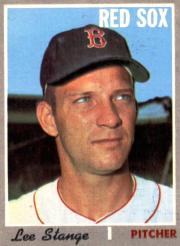
Profile of Lee Stange

Originally published on the Society for American Baseball Research.

If the Detroit Tigers had only won their final game of the 1967 season, Lee Stange would have started the most important game in nearly 20 years for the Boston Red Sox.

StangeLeeAfter the Red Sox beat the Minnesota Twins on the last day of the magical season, manager Dick Williams told Stange to take it easy in the clubhouse. If the Tigers beat the California Angels in the second game of a doubleheader, Stange would start the one-game playoff against the Tigers the following day.

The Tigers went on to lose to the Angels in the second game of the doubleheader, which gave the American League pennant to the Sox and sparked a champagne- and shaving cream-filled party in the Sox clubhouse. Without a chance to start a playoff, Stange figured he would still start a World Series game, but that didn’t happen.

“I don’t understand why I was good enough to start a playoff game, but not a World Series game,” Stange said 40 years later.

The disappointment was nothing new to Lee Stange. In a time of tall, strapping hurlers like Bob Gibson and Denny McLain, Stange suffered from the unfortunate fact of being under 6 feet tall. His career was marked by managers and front-office people telling him he was too small to start games.

He now thinks back to those days and believes that being a starter is easier than coming out of the bullpen.

“I enjoyed short relief. I think the easiest job for a pitcher is starting pitcher,” said Stange, adding that one reason is that starters know when they are going to pitch.

Albert Lee Stange was born to Albert and Dorothy Stange on Oct. 27, 1936, in Chicago. Young Lee grew up with two brothers and a sister in suburban Broadview, a small industrial community 13 miles west of Chicago with less than 10,000 people. His father worked in the mailrooms for the Chicago Daily News and the Chicago Sun-Times. Stange attended Proviso Township High School in Maywood.

At Proviso, he played three sports, including football and baseball with football legend Ray Nitschke, who was also a pitcher with control problems.

While Nitschke was listed at 6-feet-1 and 190 pounds in high school, Stange topped out at 5-feet-9. “It got to the point where everyone else grew and I didn’t,” said Stange.

Stange enjoyed an active sporting life in high school. Pitching for local coaching legend Doc Appleton, he led the 1953 Proviso Pirates to a state championship. The junior hurled a number of postseason masterpieces, including knocking off reigning state champ Morton. Finishing the year with a 7-1 record, Stange was one of five players from Proviso chosen on the Chicago Tribune’s Suburban League All-Star Team in 1953. As a senior, Stange beat Morton 8-1 in the state tournament, striking out 10 and surrendering eight hits. But the chance to repeat as state champs ended with a loss to York High School.

Professional scouts took notice of the Broadview pitcher. Washington Senators scout Ossie Bluege approached him about a contract, but Stange declined the offer, saying that he was headed to Drake University.

After a successful high school pitching career, Stange’s college time was not nearly as glorious. The freshman quarterback hurt his knee in a football game and later reinjured the knee in a scrimmage.

When the basketball season started, Stange hoped to play guard for the college team, but he twisted his leg and needed knee surgery. He missed the baseball season. “The only thing I didn’t play in college was baseball,” said Stange.

Stange left Drake with the hope of joining the military but was rejected because of his bad knee. There was only one other place to turn — pro baseball. He contacted Bluege, who sent him a $200-a-month contract with the Washington Senators. During his first year in professional baseball, Stange played for the Fort Walton Beach Jets in the Class-D Alabama-Florida League, where he struggled to a 5-6 record with a 5.40 ERA.

Stange did enjoy some success the following year with Fort Walton Beach as he won 13 games. But the following year saw him languishing in the bullpen for Appleton in the Three-I League. The young pitcher contemplated quitting baseball as he approached the end of the season with an ERA of nearly 6.00.

He talked to his manager, Jack McKeon, who asked Stange to give it another shot and the pitcher was promoted to the Wilson Tobs in the Class-B Carolina League for the 1960 season. Stange took his new league by storm. He finished 20-13 with a 3.59 ERA for the Tobs, who posted 73 wins. The young pitcher collected accolades that year, including being named the Topps Minor League Player of the Year for the Carolina League and being selected for the Carolina League All-Star Team.

“The Stinger” thought his 1960 season showed everyone that his height could no longer be used against him after he threw more than 250 innings and won 20 games. He went to the Florida Winter Instructional League, where the whole height issue returned and the Senators front office reaffirmed their view of him as a short reliever. “(The organization) always said I was too small to be a starting pitcher — even after I won 20 games,” recalled Stange.

In the November 30, 1960, Sporting News, Fred Lieb wrote how Stange was “possibly the most likely to succeed” in the instructional league’s rookie crop by displaying a curve, slider, low breaking balls, “and lots of moxie.”

Manager Del Wilber told The Sporting News, “Stange is one of the best boys here and I think he can help the parent club as a relief pitcher. While he was a starter last season in Wilson, where he pitched 251 innings, my instructions were to consider his development largely as a relief pitcher. He should be a good stopper. He has a lot of confidence, and runners on base don’t bother him. He is likely to make quite a name for himself.”

During the offseason, the Senators moved to Minneapolis-St. Paul and became the Minnesota Twins. Stange made the club out of spring training, as teams were allowed to carry 28 players. After two relief appearances, he spent the majority of the 1961 season with Syracuse (International League), where he finished 7-12, 3.78. Recalled by the club again in September, he won his first major-league game on September 15, pitching two scoreless innings against Cleveland.

“It was a new team, but most of those guys played in Washington,” Stange recalled about the Twins. “It wasn’t really an expansion team. … They had a nucleus of a pretty good team at that time.”

In 1962, Stange spent the whole season with the big club — and impressed his manager. In his first six appearances over 13 1/3 innings, Stange compiled a 1.35 ERA. Manager Sam Mele gave him a start on May 5 against Detroit, which he won 7-2 on a seven-hitter. “This was the first time I’ve gone nine innings since September 1960 at Wilson of the Carolina League,” Stange told the press after the game.

His starting career quickly ended in his next start when he gave up four runs in 1 1/3 innings against Kansas City. Stange was sent back to the pen and pitched well. He finished the season at 4-3 with a 4.45 ERA pitching for the upstart Twins, who finished second behind the Yankees.

During spring training of 1963, Stange set aside balls with seams for a day and picked up balls with three holes. He won The Sporting News‘ Major League Bowling Championship in Tampa, Florida, and Stange and bowling became synonymous for many in the baseball press. They photographed him on the pitcher’s mound with a bowling ball and The Sporting News didn’t let a mention pass without a line about his bowling expertise.

The Brunswick bowling company signed Stange to tour Minnesota, Iowa, and the Dakotas during the winter on exhibition tours. One year, Stange said, he was offered a sponsorship to go on the pro tour, but he declined.

Forty years after his brush with bowling fame, Stange said hitting the lanes in the winter helped his arm. “I think it kept my arm stronger,” he said.

Stange once again found himself in the minors in 1963. This time, he pitched for the Dallas-Fort Worth Rangers of the Pacific Coast League. Pitching as a starter, Stange went 7-1 with a 2.05 ERA. He completed five games and allowed 53 hits in 66 innings. In one start, he held San Diego to three hits and struck out 15 in a 4-0 win. All Stange needed was to gain confidence, in the view of Dallas-Fort Worth manager Jack McKeon.

After a little more than a month in the minors, Stange was recalled on June 15 and was in the majors for good. He enjoyed a strong second half, picking up 12 wins and collecting a 2.62 ERA for the year. After the season, Stange was honored by the Minneapolis Baseball Writers as the most improved player

The year 1964 saw its highs, lows, and changes for Stange. After a rough two months with the Twins in which he won only three games and compiled a 4.74 ERA for Minnesota, the team traded him to Cleveland with minor-leaguer George Banks for Jim “Mudcat” Grant. Many Cleveland fans spoke out about the trading of fan favorite Grant.

Stange went from a team on the rise to a mediocre club that at the time was rumored to be leaving Ohio. “It was kind of hard going to Cleveland,” he recalled. “It wasn’t everyone’s favorite place.”

But Stange pitched better for the Indians (finishing 7-14, 4.41 between the two clubs) and even tied a major league record in one game. In the seventh inning of a 9-0 win over the Senators on Sept. 2, 1964, he struck out four batters: Don Lock, Willie Kirkland, Don Zimmer, and John Kennedy.

The following season saw Stange back in the bullpen as Sam McDowell, Luis Tiant, Sonny Siebert, and Ralph Terry started in the rotation. Stange did occasionally start because of injuries. He had a fine season in the two roles, ending up 8-4, 3.34

In early June 1966, Stange was traded along with Don McMahon for Dick Radatz, whose once promising career had taken a decided turn for the worse. For the second time in three years, Stange was involved in a trade that was panned by fans of his new team. Though Sox fans had turned their venom on Radatz, the team could have surely gotten more for him than Stange and McMahon, said the experts. But Tribe manager Birdie Tebbetts predicted big things for Stange in Boston.

His Red Sox career didn’t start positively as he gave up five runs in three innings against the Yankees on June 3. But Stange found his groove during the second half of 1966, pitching seven complete game victories, including a two-hitter against the Yankees on September 23. After his 8-9 season, the Boston Baseball Writers gave Stange the Unsung Hero Award at their annual banquet.

Stange said the Sox players saw in 1966 that something special was happening. “I think everybody thought that after finishing ’66 so good that we could be a pretty good team,” he said.

The next season saw a new Red Sox skipper. Fiery Dick Williams took over leadership and served as an adversary for Stange during the pennant-winning season. “I think Dick was a very good baseball man. He wasn’t much fun to play for. He didn’t have much of a personality,” said Stange.

Though he didn’t get along with the manager, Stange was used mostly as a starter in ’67 and enjoyed some of his best stuff in his career. Stange remembers throwing the best game of his career on July 31 against the Twins. He threw 6 2/3 innings of perfect baseball before allowing a single to Harmon Killebrew and wound up tossing a three-hit shutout.

Though Stange won only eight games in 1967, he led the staff with a 2.77 ERA. After almost starting a playoff game against the Tigers, Stange was used once in relief in the World Series against the Cardinals, going two innings and giving up one unearned run in a 5-2 Cardinals’ win in Game Three.

After a successful season as a starter, Stange was back in the bullpen in 1968. Pitching alongside Sparky Lyle in short relief, he led the staff with 50 appearances and 12 saves. Stange came in fourth in The Sporting News‘ Fireman Award for the American League.

In the following season, the flexible Stange was called on to start 15 times among his 41 appearances. He was 4-8, 4.45 as a starter, but 2-1, 2.34 out of the bullpen.

In the middle of the 1970 season, with Stange struggling with an ERA well over 5.00, the Chicago White Sox picked him off waivers from the Red Sox. Stange told the press after the waiver deal that he enjoyed his time in Beantown, adding, “I hope I can help Chicago. If not, this may be my last year, we’ll have to wait and see.” He didn’t have to wait long. In his first start with the White Sox, Stange went 1 1/3 innings and gave up seven hits.

Stange retired as a player after the 1970 season and was named minor-league pitching instructor by the Red Sox in 1971. The following year, he took over the major-league pitching coach duties from Harvey Haddix. Stange became the 10th pitching coach in 13 years for the Sox. He told The Sporting News, “I’m thrilled and surprised with the appointment. I had no idea a chance to coach in the major leagues would come so quickly.”

Stange lasted as pitching coach through the 1974 season when he was fired, and coached with the Twins the following year. Stange later coached for Oakland before he went back to Boston in 1980 under manager Ralph Houk. Houk was Stange’s favorite manager. “He was just great to work for. He was a great old baseball man. I think everybody loved playing for him, working for him,” said Stange.

During his second tenure with the Red Sox, Stange helped the progression of eventual big-league winners Dennis Eckersley, Bob Ojeda, John Tudor, Bruce Hurst, Roger Clemens, and Curt Schilling.

Talking to The Sporting News in 1984, Hurst praised Houk and Stange. “They stuck with me, showed their confidence in me and gave me the chance to prove myself,” he said.

The Sox didn’t show the same confidence in Stange. He was replaced by Bill Fischer as pitching coach after the 1984 season, and again became minor-league pitching instructor, a job he held for the next 10 years.

While working as a minor-league pitching instructor, Stange helped Ken Ryan, who stands out in Stange’s mind as someone he helped get to the majors. At the time, Stange said, no manager wanted Ryan. The coach worked with Ryan in spring training at Winter Haven, Florida, and convinced him that the reliever’s job was a better role for him though the tall hurler wanted to start. “I said, ‘You sit with me and you throw and don’t ask me when you’re starting. You’re not starting,'” Stange recalled telling Ryan. Ryan found himself in the bullpen and wound up enjoying an eight-year career in the majors with the Sox and Phillies.

Looking back on his career, Stange said Gary Bell was a favorite teammate. The Stinger joked that he thought he was rid of Bell after Stange was traded from Cleveland, but Bell wound up with Boston, too. “Bell kept everybody loose. He’s the same way today. He hasn’t changed a bit in 40 years,” said Stange.

Stange still sees some of his former teammates at fantasy camps and autograph shows. Though he has been out of major-league baseball for more than two decades, he continues to help young pitchers as a coach with the Florida Tech Panthers in his current hometown of Melbourne, Florida.

He doesn’t remember who coined his nickname, Stinger. “I remember being called Stinger a long time,” said Stange. “I was called stinker a lot of times, too.”

Looking back at the 1967 season, Stange views the year as a highlight of his career, not only because of the pennant-winning team but the men he played alongside.

“I think we pretty much enjoyed it because we were winning and had a great bunch of guys. We got along well and hung out together all the time,” Stange said.

Books

Profile of Galen Cisco

Originally published on the Society for American Baseball Research.

Though Galen Cisco pitched in nearly 200 games over his seven-year major league career, his athletic accomplishments were much more substantial than that, appearing in the Rose Bowl as a young man, and still helping major league pitchers four decades later.

CiscoGalenGalen Bernard Cisco was born on March 7, 1936, to Beryl and Esther Cisco in St. Marys, Ohio, a small town near the Indiana border, halfway between Dayton, Ohio, and Fort Wayne, Ind. The Ciscos owned their own farm, and Galen and his three brothers and one sister spent hours working in the family business. “We kind of had a really great family life,” Cisco recalled. “We were brought up on the farm. … Everyone had their chore and we all did the things that we needed to do growing up on the farm.”

When young Galen wasn’t taking care of livestock, he squeezed in time playing sports, namely football and baseball. Cisco attended Memorial High School in St. Marys, where he played both sports for the Roughriders. His football coach was Jack Bickel, who had been a running back at Miami (Ohio) University for Woody Hayes. Cisco recalled that many of the plays in the Memorial playbook were the same ones Hayes later ran at Ohio State.

Like most young Buckeyes, Cisco dreamed of playing for Ohio State University. After graduating from high school in 1954, he enrolled at Ohio State with a major in education. Freshmen were not allowed to play on varsity teams in that era, so the pride of St. Marys spent a year practicing with the varsity. Once Cisco got the chance to play, he excelled in both sports. He sported a 12-2 collegiate pitching record and was named a third-team All-American in 1956. But he gained greater acclaim in college, as a running back and linebacker.

In his senior year, the Buckeyes went to the Rose Bowl on New Year’s Day 1958. Before a big game, many athletes focus strictly on the showdown, but that wasn’t true for young Galen Cisco. Preparing for the biggest (and final) gridiron game of his college career, he made a life-changing decision. Hayes told his players that anyone who was married could bring their wives free to Pasadena, Calif., to attend the Rose Bowl game. Cisco was engaged to his longtime girlfriend, Martha. With this Rose Bowl-colored carrot dangling over their heads, Galen and Martha decided there was no reason to wait until after the football season to tie the knot.

“She married me and got a free trip to the Rose Bowl,” recalled Cisco.

The 8-1 Buckeyes were a 21-point favorite over 7-3 Oregon in the Pasadena classic, Cisco recounted, but the Ohio State offense just couldn’t get started that day. In fact, Oregon gained more yards and collected more first downs than the favorites. Ohio State still prevailed, 10-7, thanks to a 34-yard field goal by Don Sutherin in the fourth quarter.

While some players suffered under Hayes’ rough nature, Cisco enjoyed playing for him. “He was a very, very fundamentally-minded coach. He didn’t get too fancy. He didn’t pass a lot. He seemed to think that if you take a few plays and play them better than anyone else, you’re going to be successful,” said Cisco. “He was a no-nonsense guy. He probably was one of the most prepared people I have ever been around.”

Cisco’s collegiate career was coming to an end in 1958, but he didn’t need any help choosing which sport to pursue. He recalls that a few professional football teams called Hayes about the two-way star, but were told the running back/linebacker was interested in throwing baseballs — not throwing tackles. “The closer I got to the latter years in college, I thought baseball would have more longevity than football. I had an opportunity to sign so I did,” said Cisco.

Signed in 1958 by Red Sox scout Denny Galehouse, Cisco wasted no time hurling the horsehide in the minors. He pitched in 32 games for Raleigh of the Class B Carolina League and Corning of the Class D New York-Pennsylvania League that summer, with a composite record of 6-12.

Since he still was short two quarters of receiving his bachelor’s degree, he spent the 1958-59 off-season back in Columbus to finish his schooling, and Hayes hired him as the backfield coach for the freshman football team. He stayed in that position for four off-seasons, coaching future NFL stars Paul Warfield and Matt Snell, among other players.

While teaching young running backs how to find holes each autumn, Cisco spent his springs and summers becoming a more accomplished pitcher. Along with brief 1959 stops in Raleigh and Allentown (Eastern), he won 15 games with a Midwest League-leading 2.23 ERA for Waterloo. The next year he finished 3-7, but with a fine 2.93 ERA, for Minneapolis in the American Association in 1960, and joined the Seattle Rainiers of the Pacific Coast League in 1961.

Along with teammates Dick Radatz and Don Schwall, Cisco pitched for manager Johnny Pesky in Seattle. In his nine games with the Rainiers that year, Cisco finished 6-1, compiled a 1.54 ERA and completed five of his starts. Cisco was clearly ready for the call, and he quickly followed his teammate Schwall to Boston.

The Red Sox team Cisco joined had suffered through a decade of mediocrity, and in 1961 Ted Williams no longer patrolled left field for the Olde Towne Team. If fans hadn’t attended games at the nearly 50-year-old park with the great Williams in the lineup, they surely stayed away from a team made up of unproven players like Carl Yastrzemski. “The product we put on the field was not that great,” said Cisco. “It was a tough place to play. The writers there were tough.”

Cisco’s first game was a Fenway Park start on June 11, and he allowed five hits and five runs in just 2 1/3 innings against the Twins. Six days later he won a start against the Senators, but by mid-July he was out of the rotation. Cisco struggled with the second-division team (2-4, 6.71), but Red Sox management was excited about the future of their rotation with Schwall, Tracy Stallard, Bill Monbouquette, and Cisco. His former manager, Pesky, predicted Cisco was “another Schwall,” who won the Rookie of the Year in 1961.

Schwall himself said that the Galen Cisco who pitched in Boston was not the same guy who was his teammate in the minors. “When he came up here, he got off to a bad start. Then he began to press. He wasn’t pitching normally and as a result, he didn’t look like the pitcher he was when I was with him in Minneapolis and Seattle,” Schwall told The Sporting News after the 1961 season.

But Cisco showed great improvement in spring training before the 1962 season. In 28 innings, he allowed only three earned runs for a 0.86 ERA, while scattering 23 hits. Shortly before Opening Day, Red Sox manager Pinky Higgins told the press, “Nobody can believe Cisco is the same guy who was with us for the last half of 1961.”

Alas, his 1962 season with the Red Sox mirrored his struggles of the previous year. On July 27, Higgins even left Cisco on the mound to allow 16 hits and 13 runs against the Senators, finally taking him out of the game in the sixth inning. Two relief appearances later, the Red Sox placed Cisco on waivers, and he was claimed by the New York Mets.

The right-handed pitcher went from a mediocre team to one of the worst in the history of baseball. “We had guys who couldn’t hit the ball and didn’t catch it,” Cisco recalled. Cisco now played for Casey Stengel, a learning experience for the young pitcher. After splitting two decisions in September 1962, Cisco was 7-15, 4.34, in 51 games in 1963.

While in New York, “Ohio State” (Stengel’s name for Cisco) started and relieved. Despite the team’s futility, he was able to discuss the art of pitching with teammates Roger Craig, Al Jackson, Don Rowe, Bob Miller, and Larry Bearnarth, all of whom later became pitching coaches in the major leagues. “I think everybody used to talk more [then] about the game than they did later. I’m talking about in the 1990s on. I think they talked about the game much more then,” said Cisco.

While the team did not perform well, Cisco was likely the best pitcher on the 1964 Mets’ staff. Pitching in the new Shea Stadium, the right-handed hurler finished with a 3.62 ERA, while going 6-19 for the still-hapless team. In that season, Cisco’s pitching forced a future Hall of Famer to try a new pitch.

Cisco came into the 14th inning of the second game of a doubleheader against the San Francisco and proceeded to shut down the Giants. His mound opponent late in the game was Gaylord Perry, who was struggling to stay in the major leagues, but who would ultimately win 314 games and a plaque in Cooperstown. Perry was called into the game in the 13th inning, and Perry later acknowledged throwing his first spitball in this game. Cisco and Perry traded scoreless innings until Jimmy Davenport tripled in the winning run for the Giants in the 23rd inning.

Undeterred, Cisco came back in his next start and four-hit the world champion Los Angeles Dodgers, 8-0, in front of 55,000 fans at Shea. Cisco’s performances made an impression on his manager. During the 1964 season, Stengel acknowledged that the Mets had debated whether to even keep Cisco on its roster in the spring. “Then he got a little bit better and a little bit better and a little bit better. Now he’s about as good as anyone we have,” Stengel told The Sporting News.

Unfortunately, he followed this fine season by limping to a 4-8 record and a 4.49 ERA in 1965. After the season, Cisco was sent to the minors, finishing his four-year Mets career with an 18-43 record and 4.04 ERA.

After starting the 1966 season with the Mets Triple-A Jacksonville affiliate, in June he was sold back to the Red Sox, and he finished the season with their Toronto club. Dick Williams, manager of the Red Sox’s Toronto Maple Leafs team in the International League, knew Cisco was only about 60 days of service time away from his pension and wanted to help the soft-spoken Ohioan. For the season, Cisco finished 11-6 in 157 innings in his two International League stops.

Williams, who was named skipper of the 1967 Red Sox, told Cisco he would try to get him his pension. “He told me if he had a chance he would give me a look or maybe bring me up even for two years the last 30 days when teams could expand the club,” Cisco recalled. If he’d been hurting the team, Williams would have sent him down, but Williams stuck to his word in 1967 and gave him a shot. Cisco started the year with the Red Sox as a reliever. Looking back 40 years later, Cisco said the team didn’t seem special at the start.

“I think we thought we had a pretty good club. What it boiled down to was what kind of pitching staff you had,” said Cisco. “I don’t think anybody expected us to do anything like (the 1967 Red Sox eventually) did.” Cisco was used mostly in mop-up work. He pitched in 11 games and threw 22 1/3 innings for the Impossible Dream team. But shortly after the All-Star break, the Red Sox saw an opportunity to improve their bench and picked up Norm Siebern and sent Cisco to the minors to free up the roster spot.

A number of players chafed under the pressure of playing for Dick Williams, but not Cisco. “I learned a lot of baseball as a player from Dick,” he says. “He was a no-nonsense guy. You didn’t have to wonder what he was thinking about.” In this regard, Cisco added, Williams was much like Woody Hayes. “He was honest with me always. I got along with him just fine.”

For the remainder of the 1967 season, Cisco pitched for Pittsfield (0.82 ERA in 11 innings) and Toronto (2.08 ERA in 65 innings). Cisco enjoyed a renaissance in 1968 for the Louisville club (the Red Sox new International League affiliate). He led the league with a 2.21 ERA while winning 11 games for the Colonels, at one point throwing 22 consecutive scoreless innings.

After the season, Cisco was sold to the expansion Kansas City Royals, who would begin play the following spring. Unlike the Mets in 1962, though, the Royals were more mediocre than atrocious. “The Royals I think had a little bit better draft. The way the draft was set up I think the Royals had a little bit better advantage than the Mets,” Cisco said, comparing the two expansion clubs.

Despite struggling with Omaha in the early season (5.00 ERA in 10 games), Kansas City recalled Cisco in June and the Buckeye finished the season in the Royals’ bullpen. Cisco finished with a 3.63 ERA, in what would be the last 22 1/3 innings of his major league career. He was 33 years old.

The following year Omaha hired Cisco as a player-coach. The plan was to work as the pitching coach, but to take to the mound if there were injuries or the team was in dire need of an arm. He threw 76 innings and finished his final year as a player with a 2.49 ERA. Cisco also won his final six decisions, which was the longest streak in his pro career.

Just 35 years old, Cisco became the pitching coach for Bob Lemon in Kansas City in 1971. During his tenure with the Royals, he worked with such top-notch starters as Dennis Leonard, Steve Busby, and Paul Splittorff. All three credited Cisco for their successes. “I had been dropping too much on my slider and Galen got on me about throwing more over the top,” Busby told The Sporting News in 1973 after the publication named him the American League Rookie Pitcher of the Year and a year before he won 20 games with the Royals. “I guess I was doing the same thing with my fastball. I know I felt better and threw better when I went back to the old way.”

Mound ace Leonard told The Sporting News in 1976, “When I struggled last season, Galen worked with me. He told me I was dropping down too much and everything I was throwing was flattening out. He worked with me for hours and hours.”

When Splittorff contemplated quitting in the minors, Cisco talked him out of it.

“I told him you’re left-handed and your time will come when you’re going to get a shot at the big leagues. You have spent three full years playing this game and you should give it one or two more years before retiring,” Cisco told the young pitcher, who won 166 games over 15 seasons in the majors.

Cisco was the pitching coach for the Royals’ division championship teams in 1976-1978 before being let go when Whitey Herzog was fired after the 1979 season. The experienced pitching coach quickly found work as his old friend Dick Williams hired him to lead the pitchers in Montreal.

A few years later Cisco worked with Williams in San Diego. In 1987, the Toronto Blue Jays hired Cisco as their pitching coach, and within four years, his staff included Jimmy Key, Dave Stieb, Todd Stottlemyre, and David Wells. Wells, not known for his love of management, appreciated Cisco’s assistance. “Galen Cisco helped me a lot. He would help me correct little things if he saw me doing something wrong, and we would talk pitching,” Wells said in 1988.

Cisco led the Jays’ pitchers during their world championship years of 1992-1993, the first team to win back-to-back World Series in 15 years. In addition to Key, Stieb, Stottlemyre, and Wells, pitchers who threw for him during those two years included Jack Morris, David Cone, Dave Stewart, Tom Henke, Duane Ward, and Mike Timlin. “I have to give (Pat) Gillick a lot of credit, and the scouting department. After the first (championship), most teams would have stayed pretty much pat, but they brought in two or three key players … Without those players, I wonder if we would have won it back to back,” said Cisco.

Toronto did not re-sign Cisco after the 1995 season, but the year wasn’t all bad for the Ohio State graduate. He was inducted into OSU’s Varsity Hall of Fame.

Two years later, Cisco accepted his final major league job — pitching coach of the Philadelphia Phillies — under new manager Terry Francona, who would lead the Red Sox to its first World Series win in 86 years in 2004. The two friends still stay in contact via e-mail, he said. After being let go by the Phillies, Cisco worked in the Blue Jays’ minor league system before retiring after 45 years in pro baseball.

Looking back on his successful career as a pitching coach, Cisco said he doesn’t have one favorite hurler. “I think that two starters had as good stuff as anybody: one was Dave Stieb and one was Steve Rogers,” he said. The smartest pitcher? Busby. “He studied (hitters’) weaknesses and was a student of pitching. If this guy stayed healthy, he would have been something,” Cisco said of his former pupil, whose career was cut short by injuries.

Cisco pointed to Willie Blair as a pitcher of borderline talent stuck in Toronto’s Triple-A farm club, who really worked hard on his game with Cisco. Blair won 60 games in the major leagues, including 16 for Detroit in 1997. “I don’t know if I had a lot to do with it or not, but he went on and had some pretty good years,” said Cisco modestly.

In 2006 he was enjoying retirement in Celina, Ohio, only a few miles from his hometown of St. Marys. Though he doesn’t live in town any longer, St. Marys still gives the Galen Cisco Award to the Little League MVP. The award has been given since 1965 and was won by Galen’s nephew, Ty, in 1980. Though Galen is out of the game now, the Cisco baseball legacy continues. Cisco’s grandson, Mike Cisco, was a pitcher at South Carolina in 2006, and Grandpa Cisco would travel to watch Mike pitch for the Gamecocks. Galen and Martha Cisco have been together 49 years and enjoy spending time with their two boys, Galen Jr. and Jeff (both of whom played minor league ball), and their families.

After two decades, and two championships as a coach, Cisco’s memories of his own playing career have faded. Speaking of his time with the 1967 Red Sox, he says, “I wish I could remember more, but there’s been a lot of water over the dam since then,” he says.

Books

Profile of Dave Shean

Originally published on the Society for American Baseball Research.

Dave Shean was the epitome of the Deadball baseball player on the field—he sacrificed runners to the next base, played a steady second base, and collected his share of singles. Off the field, Shean was the opposite of a hard-charging deadballer – he didn’t smoke, drink, chew tobacco, or swear, and regularly attended Sunday Mass.

Shean was born to Irish immigrants, Patrick Shean (a police officer) and Mary, on July 9, 1883, in Arlington, Massachusetts, a suburb five miles northwest of Boston. He grew up with three sisters in a deeply Catholic household at 58 Medford Street, next to Mt. Pleasant Cemetery, and across the street from St. Malachy’s (later St. Agnes) Church, which played a central role in the Sheans’ religious lives.

While attending Arlington High School, Shean’s athletic abilities became evident. The school’s Clarion  reported in June 1899 that the left fielder was “playing in good style, capturing nearly everything which comes [his] way.” Shean became a star of the team both at the plate and on the mound before transferring to Boston College High School.  After graduating from BC High, he attended Fordham University where he played the infield and outfield and occasionally pitched against other college, semipro, and major-league teams.

During time off from school, he played for a team in Rutland, Vermont, in the Twin Mountain League, where he was spotted in 1906 by Philadelphia Athletics scout Jim Byrnes.  Rather than finish his schooling, Shean jumped at the chance of signing with the Athletics, who were coming off an American League pennant. Second base was already occupied by Danny Murphy, who batted just over .300 the year Shean signed. But it wasn’t only Murphy who stood in Shean’s way. A week after Shean’s debut with the Philadelphia American League team, another second-sacker and college boy, Eddie Collins, started his 25-year career. Collins went on to become one of the best second basemen in baseball history and was inducted into the Baseball Hall of Fame in 1939.

With the  Athletics finishing a disappointing fourth in 1906, Connie Mack gave Shean some playing time at the end of the season.  He played in his first major league game on September 10, 1906, collecting a hit and  a sacrifice in a 2-1 win over Washington.

Within two weeks of his first game, Shean initiated of the rarest feats in baseball – a triple play. In a game against the St. Louis Browns, Bobby Wallace stepped to the plate with runners on first and second. The two runners took off with the pitch and Wallace hit a line drive to Shean, who snared the ball and threw to shortstop Simon Nicholls, who touched second to double off Pete O’Brien and relayed the ball to first baseman Harry Davis, who retired Ike Rockenfield before he could get back to the bag at first.

After a trial in which Shean played in 22 games, collecting 75 at-bats and batting .231, the A’s sent him to Montreal in the Eastern League in 1907. The following year, Shean played for Williamsport in the Tri-State League, where he led the league with 97 runs scored and hit .282 for the league winners.

With Murphy still the starting second baseman for the A’s and young Eddie Collins waiting in the wings, Mack sent Shean to the crosstown Phillies, where he played shortstop for 14 games (with a .146 average) in 1908.

Shean’s stay with the Phillies did not last long. After he had played 36 games in 1909, the National League team sent Shean to the Boston Doves, later renamed the Braves.

Back in his hometown, Shean got the chance to play regularly for the second-division team. He led the National League in putouts, assists, double plays, and chances per game for the position in 1910, while batting .247. One of his highlights that year came when the Doves played Brooklyn. Shean was on second after a walk and a sacrifice bunt. He took off for third with the pitch to Bill Sweeney. Sweeney grounded the ball in the hole between Jake Daubert and John Hummel. Hummel gobbled up the ball and threw to Daubert at first to get Sweeney for the out. At the same time, Shean rounded third and continued to home, beating Daubert’s throw to the plate. The scamper from second to home was becoming Shean’s “specialty,” according to the next day’s Boston Globe.

Following the Doves’ 100-loss season, Boston management tried to trade Shean to the New York Giants, but the team’s board of directors ultimately killed the deal. A month later, though, Shean escaped baseball purgatory and was sent to the Chicago Cubs, who had won the National League pennant in 1910.

With Heinie Zimmerman and Johnny Evers already splitting time at second base, Shean spent 1911 playing both middle infield positions. The Chicago Tribune called Shean “an infielder of sufficient experience to jump in a regular job with the Cubs should he be needed.”

When Shean hit camp before the 1911 season, manager Frank Chance spoke positively of him, as someone who could play all four infield positions. The Tribune, however, was more impressed with the second baseman’s wardrobe. “Shean really is in the class by himself when it comes to the glad rags. When he struck Cub headquarters, he looked as if he had been on a strap hanger all the way from the east, for there wasn’t a crease in his garments except those put there by his valet,” according to the Tribune. The crowded infield reduced his playing time, as Shean hit .288 in just 54 games for the Cubs.

The following year, 1912, the Cubs sent Shean to Louisville of the American Association, but he refused to go to Kentucky. The Louisville team suspended him. He was traded to the Braves in May 1912. After a week, Shean was on the move again, signing with the Providence Grays of the Eastern League.

Shean played the next few seasons with the Grays and resurrected his career by showing his leadership and new-found batting prowess in addition to his hard-nosed base-running and defensive ability.  “(In Providence), he had a chance to show some stuff. He was associated with players who had ability and pep,” Fred Hoey wrote in the Boston Herald and Journal.

That first year with Providence also proved a turning point in his life off the field. He married Eleanor Toomey, who the Boston Globe called a “popular East Boston girl,” a handball player and entertainer in shows like the unusually-named East Boston Catholic Literary Association. They settled in his hometown of Arlington.

Back on the ball field, Shean replaced Roy Rock, a Providence favorite, at shortstop for the 1912 season. Out of his natural position, Shean struggled. He moved to second the following year and his play improved.

The year 1914 proved a successful one for both Shean and the Grays. The Grays won the International League pennant (the Eastern League had changed its name) as Shean, the Grays’ captain, batted .334 in 150 games, while knocking out 173 hits, 22 doubles, 14 triples, and seven home runs; he also collected 35 sacrifice hits and 25 stolen bases.

During a one-week period that season, Shean also became acquainted with two people who would impact his life. On August 18, 1914, the Boston Red Sox sent a 19-year-old pitcher named George Herman Ruth to Providence for some seasoning. “Babe” later played with Shean on the 1918 Red Sox and the two remained friends after their playing days.

The other person to make his presence felt that week was David W. Shean Jr., born on August 22, 1914, to David and Eleanor.  David Jr. was the Sheans’ only child.

Following the pennant-winning 1914 season, manager Bill Donovan left Providence and took the top job for the New York Highlanders. Rather than search outside the organization, the Grays turned to their popular second sacker to take over the Providence reins.

The Sporting News reported Shean was “the popular choice for the job….Shean will be the manager that the fans are sure to cotton to. He is a clever second baseman – the best in the International League – and will be a worthy successor to Bill Donovan.”

The Providence fans also rejoiced with the naming of the new manager. At a preseason dinner for Shean, “Fighting Dave,” as the Providence Journal called him, was celebrated.

“No leader of a Providence club ever received heartier assurance of support and cooperation than those extended to popular Bill Donovan’s successor on the occasion of his official introduction as guardian of the destinies of the champions,” the paper reported.

Shean was confident of a first-division finish, though he warned fans that the pitching was not as strong as in its championship year.

Shean picked up his first win as a manager over the Buffalo Bisons in the second game of the 1915 season. The Grays fought with the Bisons throughout the year and headed into September with a slight lead.

The Grays’ season soured, though, when the team lost doubleheaders to Buffalo and Toronto, then dropped two more games to Toronto. Buffalo edged the Grays by two games for the title. Though the Grays came up short, fans didn’t cancel an already scheduled victory party after the season. Shean received a sterling silver tea set. The Providence Journal wrote that the Grays’ fans believed “no manager ever fought harder to give the city a pennant” than had Shean.

Shean managed one more year in Providence, but before the 1917 season, with the Grays under new ownership, he lost his job in Rhode Island. Hoey wrote that Shean “was a good manager, whose maxim was ‘Never drive the men. They are human. The easiest way is the best.’ This put Dave ‘in right’ with the players and the result was teamwork in its truest sense.”

In 1917, Shean was back in the majors, playing for Christy Mathewson’s Cincinnati Reds. Shean played in 131 games for the .500 team that included Hal Chase, one of the finest first baseman and crookedest players in baseball history. Though the Reds suffered through mediocrity that year, there were memorable moments. One game of note was when Fred Toney and James “Hippo” Vaughn hooked up for nine innings of double no-hit ball. Shean played second base that day as Cincinnati knocked out its first hit in the 10th inning and won 1-0.

Shean witnessed not only near perfection while playing second base that year. He also played a part in some lunacy. One play in particular was one of the strangest scoring plays possible. The Braves’ Wally Rehg didn’t run out a ground ball hit to Chase at first base. Rather than step on the bag for the out, Chase instead flipped the ball to Shean at second, who tossed the ball to Larry Kopf at shortshop. Kopf rifled the ball to right fielder Tommy Griffith, who completed the putout to pitcher Peter Schneider, who was covering first. The scoring line was 3-4-6-9-1.

Shean continued playing steady ball, leading the league’s second basemen in putouts, assists, double plays, and chances per game. “Any player who can survive a year with Cincinnati without impairing his baseball health is indeed a wonder,” Hoey wrote.

That was the last year Shean would have to play with major league mediocrity. During spring training in 1918, the Boston Red Sox traded pitcher George “Rube” Foster – who had refused to attend spring training because of a pay cut – to the Reds for the gritty second baseman from Arlington.Shean was back home, but a starting job was not guaranteed. Second-base legend Johnny Evers, who played with Shean on the Cubs, was once again his competition.

The Sox made the move for Shean because they were concerned with Evers’ age coupled with the fact that a number of Boston’s players were eligible for the draft and the nation was at war. Shean, on the other hand, was not subject to the draft because he was 34 years old and married with a son.

After reuniting with his old Providence teammate Ruth, Shean got the start at second base for the 1918 Red Sox on Opening Day, and the Sox beat the Athletics, 7-1, with Ruth getting the win.

The early season was not all good times, though. In the second game of the season, Shean was on the wrong side of pitcher Carl Mays’ surly nature. On that day, Mays was hurling a no-hitter going into the eighth inning. Joe Dugan led off for the Athletics with a hard groundball into the hole. Shean tried to trap the ball with both hands but slipped on the outfield grass. Dugan crossed first base safely and was awarded a single. Still fuming about the play after the game, Mays told the newspapermen that Shean should have been given an error.

Following that brief bump in the road, Shean’s 1918 campaign was one of his finest. “His skill in blocking off the stick, his value as a sacrifice hitter, and his effective batting in the pinches was one of the biggest factors in the Red Sox’ drive to victory,” reported the Boston Post. “And every ballplayer in both the big leagues will freely admit that Dave is one of the wisest infielders in the game and that neither Cobb nor anyone else can put anything across while Shean is on the watch.”

He batted .264 and played in 115 games in the 126-game season, shortened because of the war. Shean missed time that year because of neuralgia, foot problems, a stomach virus, and an infected foot.

The injury bug bit Shean again while the Red Sox practiced for the 1918 World Series. He dove for a line drive and the ball struck his throwing hand, ripping the nail and skin off the tip of his middle finger. Trainer Martin Lawler wrapped the finger in a splint and Shean was ready to play in his first World Series.

In the first game, Shean scored the only run of the contest. Stuffy McInnis singled him home from second base. The Sporting News wrote of Shean’s journey home that he “runs like a turtle on an iceberg.”

After the Sox won two of three games in Chicago, the teams rode the rails back to Boston. While on the trip, players discussed their possible winnings. Dissatisfied with the new rule that the World Series pot would be split between more teams (the two league champions would take 55½ percent of the money and split it 60/40), coupled with cheaper ticket prices that hurt the size of player bonuses, the players discussed taking action.

Shean, Harry Hooper, and the Cubs’ Les Mann tried to meet with the National Commission, which ran baseball at the time but were rebuffed. The dispute resurfaced later in the Series and the players threatened to strike.

Back on the field, Shean made one of the best plays of the Series in Game Four. In the sixth inning, Ruth walked Lefty Tyler. Max Flack grounded back to the pitcher, who threw wildly to second past shortshop Everett Scott. But Shean, backing up the play, caught the ball while on his knees and dove toward the base, crawling on his stomach to tag the base before Tyler’s foot made contact. Ruth retired the next two batters and continued his scoreless innings streak that stood as a World Series record until 1962.

The Red Sox wrapped up their fifth world championship in Game Six.  Shean scored the winning run and collected the last out in a 2-1 win. Though Shean hit only .211 in the series, he scored the first and final runs. Those were the only runs he scored in the six games, but then again, the Red Sox scored only nine runs in all.

World Series champion teams usually have a joy-filled off-season, but not the 1918 Red Sox. Baseball’s hierarchy was upset with the players’ “greedy” demand for more money during the Series. While previous winners received $3,000 to $4,000 for winning the Series, which was more than the annual salaries of most of the players, the Red Sox players collected only slightly more than $1,100.

National Commission member John Heydler told the players they would not receive their World Champion emblems “owing to the disgraceful conduct of the players in the strike during the series.” In response, Sox owner Harry Frazee bought several of the players pocket watches engraved with their names and “Red Sox 1918 champions,” but the National Commission snub haunted the players long after their playing days.

Shean’s grandson, Henry, said his grandfather didn’t talk much about his baseball career, which he said could have been because of the 1918 slight. “Growing up, we always talked about the Red Sox. But he didn’t talk about his career. I think he may have been unhappy about the way things went down,” said Henry Shean.

For the following decades after the snub, Hooper sent letters to the baseball commissioners asking for the team’s emblems. In one printed letter, the Hall of Famer even mentioned Shean, noting that 1918 was his only World Series appearance. Seventy-five years after the snub and nearly 10 years after Hooper’s death, the relatives of the 1918 Red Sox finally received their honors. During a ceremony at Fenway Park, the Red Sox gave the families commemorative pins in honor of the 1918 season.

After the World Series year of 1918, Shean played in only 29 games and was batting just .140 when the Red Sox released him in August 1919.

Many baseball players struggle with lives after baseball, but not Shean. He returned to his position at Nathan Robbins Company, a poultry firm that employed him during the offseason.

In a December 1918 story in the Boston Post, Hoey wrote, “When the baseball season is over, Dave does not sit around clubrooms or pool halls and tell the natives what’s best in baseball. Instead he exchanges his baseball uniform for a butcher’s frock and (goes) to the big market where he handles more fowls.”  Shean spent decades after baseball working for the poultry company in the dank basement of Boston’s Quincy Market.

“You get a tough one now and then just the same as you do in baseball,” Shean said of his poultry work. “Once in a while, I run across one that has spurs like those that Ty Cobb wears.  I sidestep those babies.  There are all kinds of birds in the poultry game as there are in the big leagues.  I get plenty of chances to size up all the varieties.”

Shean worked his way up the company ladder and became president of the business. “His personality is one of the firm’s biggest assets and the Dave Shean smile brings hundreds of new customers every year,” reported the Boston Post.

Shean stayed in touch with the game. According to reports at the time, the Arlington man made trips to Fenway Park when his old friend Babe Ruth came to town with the Yankees. During those visits, Shean presented the Babe with poultry, which the Sultan of Swat devoured.

“He didn’t make it a point to talk about his famous friends,” recalled his granddaughter Leslie Flanagan. “He didn’t make a big deal out of it though he really had quite an exciting life as a younger man. He was very modest about the whole thing.”

Shean remained with the poultry business until the end of his life. His only child, David Jr., who served in World War II and graduated from Harvard University, followed in his father’s footsteps by taking over the leadership role at Nathan Robbins Company. Though Shean did not return to pro ball after his retirement, he played and coached baseball on Arlington’s Spy Pond Field. He also participated in old-timers games in the Boston area.

Shean’s life came to an end in 1963 after the 77-year-old widower suffered numerous injuries in a car accident. He died at Massachusetts General Hospital on May 22. His death was mourned by his hometown. The local newspaper, the Arlington Advocate, called Shean “one of Arlington’s best known and loved citizens.”

Advocate columnist Leonard Collins wrote that Shean was “a very quiet and unassuming man. Dave hardly talked about his playing days, but on such occasions, he was wonderful to listen to as he spoke of the men who were known all over the country.” Shean’s funeral was held at St. Agnes Church, where he had spent many hours attending services. He was buried at St. Paul’s Cemetery in his hometown.

Thinking back on her father-in-law’s life, Helen Shean remembered the former ballplayer as the “most generous, thoughtful, quiet man I ever knew.”

After his death, Advocate columnist Collins summed up Shean’s life by writing, “On or off the field, Dave did just great. His quiet charities over the years were many and no one would know about these if the recipients had not divulged his name. Arlington was his home always and he never lost interest in its people or activities.”